How to Tell Time in French: A Simple Guide
Learning to tell time in French is a vital skill. It helps in daily activities like catching a train, setting appointments, and making plans with friends. This guide makes learning easy by covering essential vocabulary, common phrases, and practical tips. Start mastering French time-telling today!
Key Takeaways
- Knowing how to ask and tell time in French helps you communicate smoothly in daily conversations, travel situations, and casual meetings.
- Use the phrase “Il est … heure(s)” properly and remember to include “heure(s)” whenever you mention the time in French.
- Learn simple phrases like et quart (quarter past), et demie (half past), and moins le quart (quarter to) for everyday use.
- Understand when to use the 24-hour format or add phrases like du matin, de l’après-midi, and du soir for clarity.
- Keep practicing “Quelle heure est-il ?” and replying naturally to sound confident and fluent in real French conversations.
How to Ask What Time It Is in French?
In French, asking the time is not just about getting information: it’s also about choosing the right tone. Whether you want to sound polite, formal, or casual, there are different ways to ask the same question. For example, Would you tell me the time, please?, in street French it would be, Auriez-vous l’heure, s’il vous plaît ?. From standard expressions to relaxed, everyday phrases, learning these French essentials helps you communicate more naturally and confidently in different situations.
| French Phrase | English Translation | Pronunciation |
|---|---|---|
| Quelle heure est-il ? | What time is it? | kel uhr eh-teel? |
| Avez-vous l’heure ? | Do you have the time? | ah-vay voo luhr? |
| Il est quelle heure ? | What time is it? | eel eh kel uhr? |
| Pouvez-vous me dire l’heure ? | Can you tell me the time? | poo-vay voo muh deer luhr? |
| À quelle heure… ? | At what time…? | ah kel uhr…? |
How to Tell Time in French?
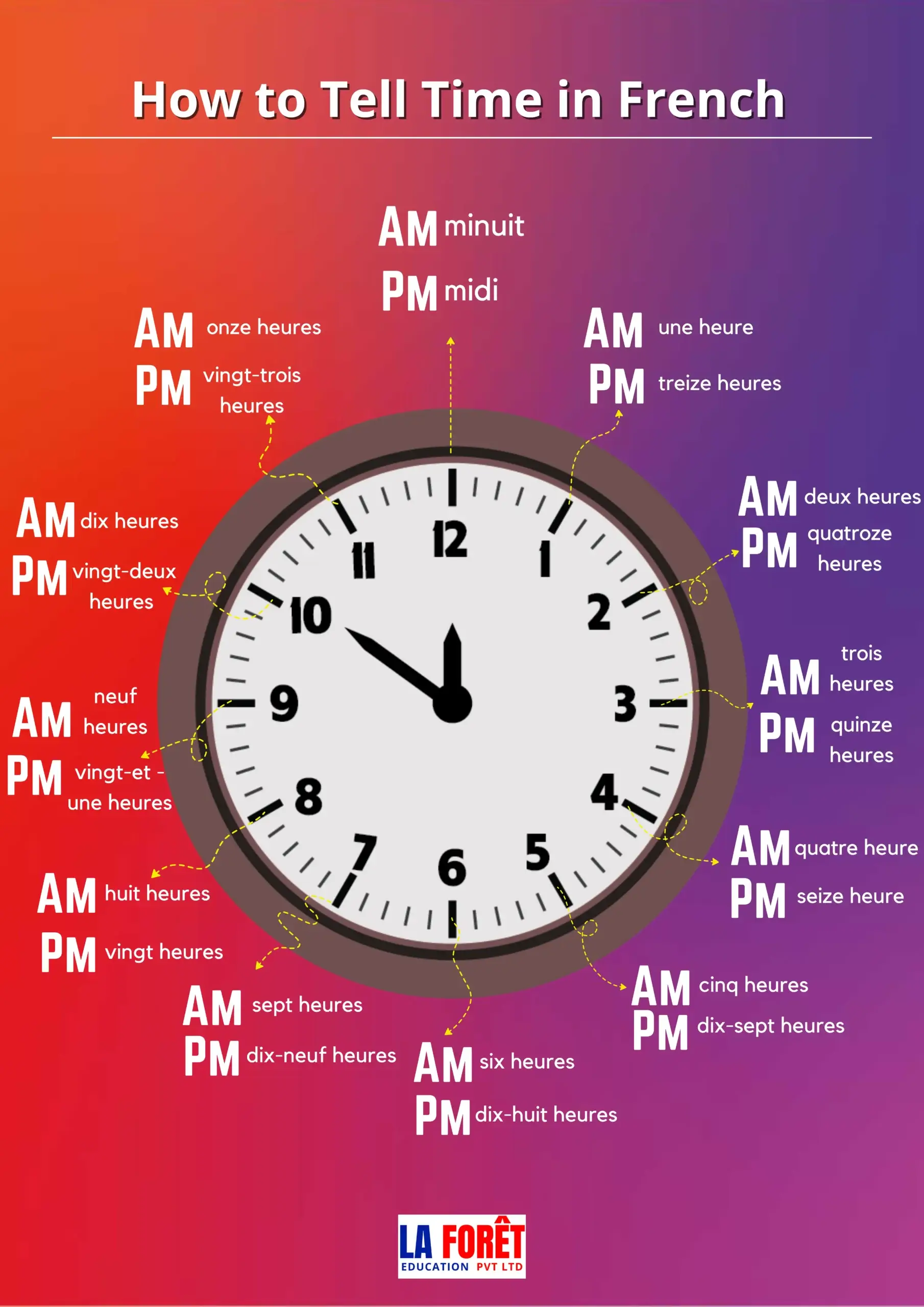
In French, telling time is slightly different as the French use a 24 hour clock instead of 12 hour one, especially in formal contexts like schedules, travel, and school timetables. So, suppose when you want to say It’s one o’clock, for afternoon, you have to say Il est treize heures.
To tell time in French, you generally start with “Il est…” (It is…). For example, “Il est deux heures” (It is 2 o’clock) or “Il est dix heures” (It is 10 o’clock). Understanding both the 24-hour system and these common expressions will help you tell time naturally and confidently in French.
Note: “Heure” is singular when referring to 1:00 (e.g., “une heure”) and plural for all other hours (e.g., “deux heures”).
Telling Time in French Using the 12-Hour Clock.
Although the 24-hour clock is standard, the 12-hour format is still used in informal conversation. For example, people may say “Il est huit heures du matin” for 8 o’clock in the morning to specify whether it’s morning or afternoon. However, the 24-hour system remains more precise and commonly used overall.
| English | 12 Hour Format (French) | Pronunciation |
|---|---|---|
| 1:00 AM / 1:00 | 01h00 | uhn uhr |
| 2:00 AM / 2:00 | 02h00 | duh uhr |
| 3:00 AM / 3:00 | 03h00 | trwah uhr |
| 4:00 AM / 4:00 | 04h00 | katr uhr |
| 5:00 AM / 5:00 | 05h00 | sank uhr |
| 6:00 AM / 6:00 | 06h00 | sees uhr |
| 7:00 AM / 7:00 | 07h00 | set uhr |
| 8:00 AM / 8:00 | 08h00 | weet uhr |
| 9:00 AM / 9:00 | 09h00 | nurf uhr |
| 10:00 AM / 10:00 | 10h00 | dees uhr |
| 11:00 AM / 11:00 | 11h00 | onz uhr |
| 12:00 PM / 12:00 | 12h00 | dooz uhr |
Telling Time in French Using the 24-Hour Clock
In French, the 24-hour clock is commonly used, especially in daily life, schedules, and formal situations. You begin with “Il est…” (It is…) followed by the hour in 24-hour format. For example, “Il est vingt heures” means 8 p.m., and “Il est dix-huit heures” means 6 p.m. This system avoids confusion between morning and evening and is widely preferred in France.
| English | 24 Hour Format (French) | Pronunciation |
|---|---|---|
| 12:00 PM / 12:00 | 12h00 | dooz uhr |
| 1:00 PM / 13:00 | 13h00 | trehz uhr |
| 2:00 PM / 14:00 | 14h00 | kahtorz uhr |
| 3:00 PM / 15:00 | 15h00 | kanz uhr |
| 4:00 PM / 16:00 | 16h00 | sez uhr |
| 5:00 PM / 17:00 | 17h00 | dees set uhr |
| 6:00 PM / 18:00 | 18h00 | dees weet uhr |
| 7:00 PM / 19:00 | 19h00 | dees nurf uhr |
| 8:00 PM / 20:00 | 20h00 | van uhr |
| 9:00 PM / 21:00 | 21h00 | van tay uhn uhr |
| 10:00 PM / 22:00 | 22h00 | van duh uhr |
| 11:00 PM / 23:00 | 23h00 | van trwah uhr |
| 12:00 AM / 24:00 | 00h00 | mee-nwee |
Do You Want Bonus Tips for Telling Time in French?
In order to sound more casual and fluent, use phrases such as “Il est midi, Il est minuit ” for “It’s noon and It’s midnight” respectively. Another important point would be to use terms like “du/le matin, le soir” to add morning and evening to the sentences for the flow.
How to say Half Past, Quarter Past, and Quarter To in French
Use these French expressions as used most often by the French people such as, “Il est cinq heures et demie” (It is 5:30). You can also add expressions like “moins le quart” (quarter to) or “et quart” (quarter past). Understanding both the 24-hour system and these common expressions will help you tell time naturally and confidently in French.
| English | French | Example |
|---|---|---|
| Half past | et demie | 3:30 – Trois heures et demie |
| Quarter past | et quart | 2:15 – Deux heures et quart |
| Quarter to | moins le quart | 4:45 – Quatre heures moins le quart |
Grammatical Notes:
- Use “et demie” for half past, except for “midi” (noon) and “minuit” (midnight), where it’s just “et demi” (without the extra ‘e’).
- Use “et quart” for quarter past, and “moins le quart” for quarter to.
- The 24-hour clock format is commonly used in formal or written contexts, whereas the 12-hour format is more common in spoken French.
How to Tell the Exact Time in French: Minutes Past and To in French.
The way exact time is said in French is different from how we say it in English. It is quite direct and is the literal version of these phrases. For example, it’s 10 past one would be “Il est une heure 10″.
| English | French |
|---|---|
| 1:05 (Five past one) | Une heure cinq |
| 2:10 (Ten past two) | Deux heures dix |
| 3:15 (Quarter past three) | Trois heures et quart |
| 4:20 (Twenty past four) | Quatre heures vingt |
| 5:25 (Twenty-five past five) | Cinq heures vingt-cinq |
| 6:30 (Half past six) | Six heures et demie |
| 7:35 (Twenty-five to eight) | Huit heures moins vingt-cinq |
| 8:40 (Twenty to nine) | Neuf heures moins vingt |
| 9:45 (Quarter to ten) | Dix heures moins le quart |
| 10:50 (Ten to eleven) | Onze heures moins dix |
| 11:55 (Five to twelve) | Douze heures moins cinq |
Grammatical Notes:
- For times past the hour, use “heure” followed by the number of minutes (e.g., “une heure cinq” for 1:05).
- For times to the hour, use “heure moins” followed by the number of minutes (e.g., “huit heures moins vingt-cinq” for 7:35).
Does the French Language Use AM and PM?
The French language has no translation for AM and PM as it uses 24 hour clock. So, when you want to say, “It’s 2 PM”, you have to say “Il est 14h00”. Here are a few more examples to help you-
| 12-Hour Clock (AM/PM) | 24-Hour Clock (French) | Example |
|---|---|---|
| 1:00 PM | 13h00 | “Le train part à 13h00.” (The train leaves at 1:00 PM.) |
| 6:00 PM | 18h00 | “Le film commence à 18h00.” (The movie starts at 6:00 PM.) |
| 11:30 PM | 23h30 | “Il arrive à 23h30.” (He arrives at 11:30 PM.) |
Learning French? Let’s Make It Easy!
Learn more about upcoming French batches
How Do You Say Time of Day Phrases?
In French, ‘time of day’ phrases are really important to know. Such as “morning” is translated as “le matin”. Here are all the important phrases that you need to know-
| French Phrase | English Translation | Usage Example |
|---|---|---|
| Le matin | Morning | “Je me lève le matin.” (I get up in the morning.) |
| L’après-midi | Afternoon | “Je fais du sport l’après-midi.” (I exercise in the afternoon.) |
| Le soir | Evening | “Nous dînons le soir.” (We have dinner in the evening.) |
| La nuit | Night | “Il dort la nuit.” (He sleeps at night.) |
| À midi | At noon | “Je mange à midi.” (I eat at noon.) |
| À minuit | At midnight | “La fête commence à minuit.” (The party starts at midnight.) |
| Tôt le matin | Early morning | “Je cours tôt le matin.” (I run early in the morning.) |
| Tard dans la soirée | Late in the evening | “Je travaille tard dans la soirée.” (I work late in the evening.) |
| En début d’après-midi | Early afternoon | “J’ai un rendez-vous en début d’après-midi.” (I have an appointment early in the afternoon.) |
| En fin de la journée | Late in the day | “Il rentre en fin de la journée.” (He returns late in the day.) |
Useful Time-Related Vocabulary
Now that you have learned all the fundamental things about how to say time in French, here are some other words that you need to use while talking about time –
| French Term | English Translation | Pronunciation |
|---|---|---|
| Horloge | Clock | or-lozh |
| Montre | Watch | mohntrr |
| Réveil | Alarm clock | ray-vay |
| Agenda | Planner | ah-zhin-dah |
| Calendrier | Calendar | kah-lahn-dree-ay |
| Chronomètre | Stopwatch | kroh-noh-metr |
| Minuteur | Timer | mee-nu-tur |
| Fuseau horaire | Time zone | fu-zoh or-air |
| Heure de pointe | Rush hour | ur duh pwent |
| Le temps (la fois) | Time | luh tahn (lah fwah) |
| Heure | Hour | uhr |
| Minute | Minute | mee-nyut |
| Seconde | Second | suh-gohnd |
| Matin | Morning | mah-tan |
| Après-midi | Afternoon | ah-pray mee-dee |
| Soir | Evening | swahr |
| Nuit | Night | nwee |
| Midi | Noon | mee-dee |
| Minuit | Midnight | mee-nwee |
| Quotidien | Daily | koh-tee-dyan |
| Quart | Quarter | kahr |
| Demi | Half | duh-mee |
| Maintenant | Now | mang-tuh-nong |
| Bientôt | Soon | byan-toh |
| Tôt | Early | toh |
Learning days of the week in French is essential for daily conversations. Check out this guide to improve your French vocabulary effortlessly.
Frequently Asked Questions
Q. What does ”h” mean in French times?
Ans: When we write time as 13h00, the “h” means the word heure which translates to ‘hour’. It is used as the French equivalent of AM/PM. For example, when we say “Il est 3h00” we mean to say “Il est trois heures”, which translates to “It’s 3AM (or PM)” (three o’clock).
Q. What Should You Know About the Times of the Day?
Ans: In French, expressions like le matin, “l’après-midi, le soir, and la nuit” are used to clarify the time of day. For instance, “Il est huit heures du matin or du soir ” avoids ambiguity between morning and evening. While the 24-hour clock is common, these phrases remain essential in spoken French for precision and natural flow.
Q. What Is the Difference Between the 12-Hour and 24-Hour Clock?
Ans: The major difference between 12-hour clock and 24-hour clock is that when you use 12 hour clock, you need to use AM/PM to distinguish between morning and night. Although, it’s obvious with 24-hour clock after 13 starts. However, in French speaking country, they don’t have AM/PM, hence the use of a 24-hour clock is more natural.
Q. What Are the Key Time Expressions in French?
Ans: The key time expressions in French include le matin (morning), l’après-midi (afternoon), le soir (evening), and la nuit (night), which help situate an action within the day. To express time precisely, French also uses structures like à (at), de… à… (from… to…), and vers (around).
Q. How do you say 17:45 in French?
Ans: In French, 17:45 is expressed as “dix-sept heures quarante-cinq” in the 24-hour format. Alternatively, you can say “six heures moins le quart” for 5:45 PM in the 12-hour format.
Q. How do you say 8:30 in French?
Ans: In French, 8:30 is expressed as “huit heures trente” in the 24-hour format. In the 12-hour format, you would say “huit heures et demie.”