Days of the Week in French | Learn How to Say Them Easily

Knowing the days of the week in French is crucial for effective communication and daily routines. It helps in scheduling appointments, making plans, and understanding timetables. For instance, “lundi” means Monday, “mardi” means Tuesday, and so on. This knowledge simplifies interactions in French-speaking environments.
Learning the days of the week not only aids in practical communication but also enhances cultural understanding and integration. This article dives into mastering French days of the week, offering usage rules, sentence examples, memory tips, and related vocabulary. You’ll learn how to use weekdays in sentences, remember them effortlessly, and expand your French language skills. Whether planning schedules or simply conversing, understanding these days is key to effective communication and cultural integration.
Key Takeaways
- French weekdays like “lundi” and “mardi” are very easy to learn and follow a simple pronunciation pattern.
- Unlike English, French days of the week are not capitalised unless they begin a sentence, which makes writing them a bit different from English.
- To talk about repeated events like “every Monday,” you use the definite article “le” before the day: le lundi, le vendredi.
- When describing a routine that happens during a stretch of days (like Monday to Friday), use the phrase “du lundi”, “au vendredi” in French.
What Are the Days of the Week in French?
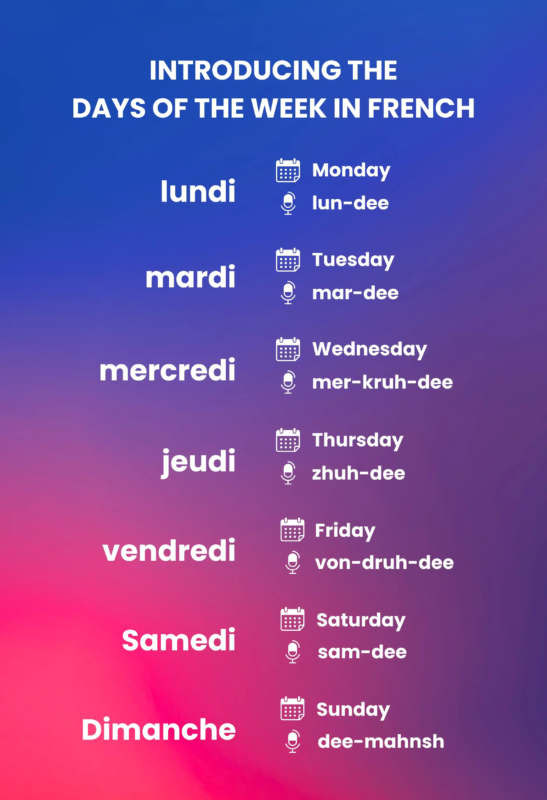
In French, the days of the week follow a pretty standard structure. Unlike the English calendar, which often starts on Sunday, the French week always begins on a Monday (lundi). This is actually pretty standard across most of Europe and follows the ISO 8601 standard. Now, places like the USA or Canada might view Sunday as the first day of the calendar, whether you’re using French or English, but France keeps the weekend strictly at the end of the week.
| French | English | Pronunciation |
|---|---|---|
| Lundi | Monday | [lun-dee] |
| Mardi | Tuesday | [mar-dee] |
| Mercredi | Wednesday | [mer-kruh-dee] |
| Jeudi | Thursday | [zhuh-dee] |
| Vendredi | Friday | [von-druh-dee] |
| Samedi | Saturday | [sam-dee] |
| Dimanche | Sunday | [dee-mahnsh] |
French Days of the Week Song
Memorising the French Days of the Week
Getting to grips with the seven days of the week in French is vital if you want to be able to navigate your day to day life with ease. Most of these names actually come from Roman mythology and planets, which makes them a lot easier to link to English if you know where the roots are coming from. Mastering these weekdays in French will give you a confidence boost when it comes to chatting in French about your daily routine.
Monday in French – lundi
The word lundi comes from the Latin Lunae dies, which literally translates to “Moon Day”. When youre saying it out loud though, its actually pronounced a bit more like “loon-dee”.
- Example: Je travaille le lundi. (I work on Mondays.)
- Tip: Try and remember that its got something to do with the moon – might be something like “Lunatic” or “Lunar” to help you recall it.
Tuesday in French – mardi
Named after Mars, the god of war, mardi is pronounced “mar-dee”. This is probably one of the French words for the week that you’ll be using most often.
- Example: Le match est mardi. (The match is on Tuesday.)
- Tip: Think of Mars when you say this one.
Wednesday in French – mercredi
This one is dedicated to Mercury. When you say it out loud, its actually “mair-kruh-dee”. It is often a half-day for many French schoolchildren, so you might well hear or use this one a lot.
- Example: Nous voyageons mercredi. (We travel on Wednesday.)
- Tip: Try and link it to Mercury – might be something like “Mercury” or even “Mer-Can”.
Thursday in French – jeudi
So this one is named after Jupiter and is pronounced “zhuh-dee”. This is actually a pretty key part of the week in French, and is often a pretty busy day for most people.
- Example: Il arrive ce jeudi. (He arrives this Thursday.)
- Tip: Think of Jupiter when you say this one.
Friday in French – vendredi
There’s actually a pretty direct link to Venus with this one – it’s pronounced “von-druh-dee”. This one marks the end of the traditional week for many people.
- Example: Cest vendredi! (Its Friday!)
- Tip: Try and link it to Venus – might be something like “Venerable” or “Venus Star”.
Saturday in French – samedi
This one actually comes from the Sabbath, and is pronounced “sam-dee”. This is pretty much the first day of the weekend in French.
- Example: Je sors le samedi. (I go out on Saturdays.)
- Tip: Sounds a bit like “Sam’s Day” to me.
Sunday in French – dimanche
The final day of the week in French is actually dimanche, which is pronounced “dee-mansh”. This translates to “Lord’s Day” from the Latin.
- Example: Le magasin est fermé dimanche. (The shop is closed on Sunday.)
- Tip: Try and link it to “Dominion” or something like that.
Chart to Help You Remember the French Days of the Week
Mnemonics are memory tricks that make learning fun. Create a catchy sentence using the first letter of each day to remember the French days of the week. There is another interesting way of remembering the days of the week in French which corresponds to the celestial bodies.
Now, if you want to make sure you don’t forget the days in French, we’ve put together a little chart below to help you out.
| English | French | Mnemonic |
|---|---|---|
| Monday | lundi | Moon |
| Tuesday | mardi | Mars |
| Wednesday | mercredi | Mercury |
| Thursday | jeudi | Jupiter |
| Friday | vendredi | Venus |
| Saturday | samedi | Sabbath |
| Sunday | dimanche | The Lord’s Day |
Top Tips to Use the Days of the Week in French
So, now that you know the days in French, you’ve got to know a few basic rules of grammar to make sure you sound like a local and don’t make any rookie mistakes when talking about your French vocabulary.
Capitalisation
Now, unlike in English, days of the week in French don’t get capitalized unless they’re at the start of a sentence. So you would write “lundi” instead of “Lundi”. This is actually a pretty common mistake for English speakers to make.
Definite Article – Plurals follow simple rules
To make French days plural, you simply add an ‘s to the end (although some days like dimanche can get a bit irregular). However – using “le” + singular day is more of the norm when describing habits.
Using “du” for Days
When you want to say “from Monday to Friday,” you use “du… au…” like you would with any other range of days (du lundi au vendredi). This is actually pretty helpful when checking business hours or public holidays in France.
Lost for Words? We’ve Got You!
Sign up for our courses and let our expert teachers boost your vocabulary effortlessly!
“Le Weekend” for Weekend
The French actually use the English word “weekend”, but they give it a bit of a French twist – it’s always masculine: le weekend. This is a pretty common part of french week day conversations.
“Ce” for This Week
When talking about a specific day in the current week, use “ce” (this). For example, “ce mardi” means “this Tuesday”. This helps to clarify that you aren’t talking about every Tuesday.
Avoid “le” with Days After “tout”
If you want to say “all Monday,” you use “tout lundi”. You don’t need to add the article “le” in this particular construction – it just keeps the sentence flowing nice and easy.
To learn how to say months in French, visit this helpful guide on the Months of the Year in French.
How to Use French Days of the Week in a Sentence
Putting your learning into practice is the best way to really get to grips with it. Here’s how you can use the french days of the week in real-life contexts.
- Quel jour sommes-nous ? (What day is it?)
- Aujourd’hui c’est lundi. (Today is Monday.)
- Je vais au cinéma le samedi. (I go to the cinema on Saturdays.)
- Nous avons rendez-vous mardi.(We have a meeting on Tuesday.)
- Le magasin est ouvert du lundi au vendredi. (The shop is open from Monday to Friday.)
- Qu’est-ce que tu fais ce jeudi ? (What are you doing this Thursday?)
- Je déteste les lundis. (I hate Mondays.)
- Il arrive mercredi soir. (He arrives on Wednesday evening.)
- Bon vendredi à tous !(Happy Friday to you all! ) Dimanche est un jour de repos.
- Dimanche est un jour de repos. (Sunday is for resting. )
Days of The Week in French: Related Vocabulary
To get a good grasp of days in French, you also need to know these related time-markers:
| English | French |
|---|---|
| Yesterday | Hier |
| Today | Aujourd’hui |
| Tomorrow | Demain |
| Last week | La semaine dernière |
| This week | Cette semaine |
| Next week | La semaine prochaine |
| Last month | Le mois dernier |
| This month | Ce mois-ci |
| Next month | Le mois prochain |
| Morning | Le matin |
| Afternoon | L’après-midi |
| Evening | Le soir |
| Night | La nuit |
| Now | Maintenant |
| Later | Plus tard |
| The day before yesterday | Avant-hier |
| The day after tomorrow | Après-demain |
| At what time? | À quelle heure? |
| Weekday | Jour de la semaine |
| Weekend | Week-end |
| Day | Jour |
| Week | Semaine |
| Month | Mois |
| Year | Année |
| Season | Saison |
| Hour | Heure |
| Minute | Minute |
| Second | Seconde |
| Midnight | Minuit |
| Noon | Midi |
| Last year | L’année dernière |
| Next year | L’année prochaine |
| Early bird | Lève-tôt |
| Late riser | Couche-tard |
Conclusion
Understanding the French days of the week is essential for fluent communication and daily interactions. Pronunciation, usage rules, and related vocabulary enrich language proficiency. Regular practice enhances retention and application. Encourage French language skills through immersion, conversations, and cultural engagement. Continuous learning deepens language fluency and cultural understanding.
Mastering French during the days of the week is crucial for seamless communication. La Foret French Class offers comprehensive courses and expert tutors to support your language journey, ensuring effective learning and mastery. Keep exploring, practicing, and incorporating French days of the week into your daily language use to become more proficient and confident in French.
Frequently Asked Questions
Q1: How to pronounce weekdays in French?
Ans: To pronounce weekdays in French, remember their sounds: “lundi” (luhn-dee), “mardi” (mar-dee), “mercredi” (mehr-krud-ee), “jeudi” (juh-dee), “vendredi” (vahn-druh-dee), “samedi” (sahm-dee), and “dimanche” (dee-mahsh).
Q2: Are weekdays masculine or feminine in French?
Ans: Weekdays are masculine in French. For example, it’s “le lundi” (luh luhn-dee) for Monday, using the masculine article “le” with weekdays.
Q3: What is the order of the days of the week in French?
Ans: The order is Lundi, Mardi, Mercredi, Jeudi, Vendredi, Samedi, and Dimanche – unlike some other calendars that kick off on Sunday, the French one is pretty strict about starting on Monday.
Q4: How to remember the days of the week in French?
Ans: Try associating each name with a planet or a Roman god – it can be a pretty clever way to get them to stick in your memory. Alternatively, you could try using flashcards or changing your phone’s language setting to French – you’ve got to see them in context a few times to make them really stick, after all.
Q5: Do the French use the same abbreviations for the days of the week as the English do?
Ans: No way – they have their own set of abbreviations. Usually, it’s just the first letter or two: L (lundi), Ma (mardi), Me (mercredi), J (jeudi), V (vendredi), S (samedi), and D (dimanche). You can spot them on calendars all over the place.
Q6: What are the 12 months in French?
Ans: The months go like this: janvier, février, mars, avril, mai, juin, juillet, août, septembre, octobre, novembre, and décembre – just like the days, they don’t get big letters in French.