Studying Geography in French: Vocabulary of Landscapes
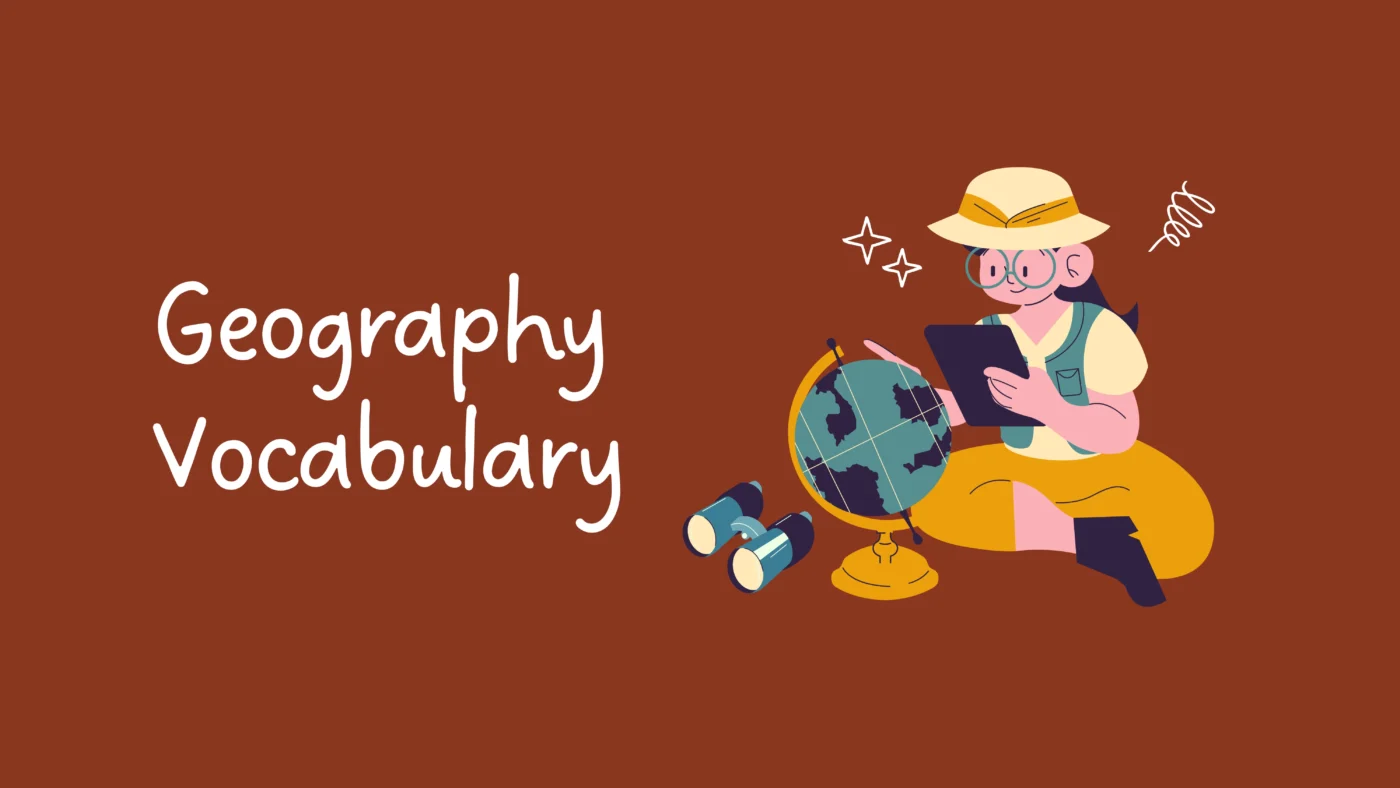
Learning French geography vocabulary is crucial for travellers to France and those improving their language skills. France boasts diverse landscapes, from mountains to beaches. Knowing terrain-related terms enhances communication and enriches the travel experience.
Key Takeaways
- Learn basic vocabulary regarding geography, such as montagne (mountain), vallée (valley), plaine (plain), forêt (forest), lac (lake), for everyday landscape chats.
- Know the small vocabulary related to Mountains or hills, such as le sommet (summit), le pic (peak), la pente (slope), le col (pass), le plateau (plateau).
- Learn vocabulary related to water features such as la mer (sea), l’océan (ocean), la rivière (river), la plage (beach), le port (port).
- There are also Forest or coast-related words you would learn la forêt (forest), la clairière (clearing), la falaise (cliff), la dune (dune), l’oasis (oasis).
- Learn the special spots words such as le volcan (volcano), la grotte (cave), le canyon (canyon), le geyser (geyser), la cascade (waterfall).
The Basics: Types of Landscapes
Fundamental Landscape Terms
Understanding French landscape vocabulary helps describe the country’s diverse terrains. Here are some fundamental terms:
| French Term | English Translation | Definition |
|---|---|---|
| Montagne | Mountain | A high, steep area of land |
| Vallée | Valley | A low area between hills or mountains, often with a river |
| Plaine | Plain | A large area of flat land with few trees |
| Forêt | Forest | A large area covered chiefly with trees and undergrowth |
| Désert | Desert | A barren area of landscape with little rainfall |
| Lac | Lake | A large body of water surrounded by land |
| Rivière | River | A large natural stream of water flowing towards an ocean or lake |
| Mer | Sea | A large body of saltwater smaller than an ocean |
| Océan | Ocean | A vast body of saltwater covering a large part of the earth’s surface |
| Colline | Hill | A naturally raised area of land, not as high as a mountain |

Mountains and Hills
Understanding the vocabulary for mountains and hills is essential for describing different elevations and terrains in French.
Key Terms for Mountains
| French Term | English Translation | Definition |
|---|---|---|
| Le sommet | The summit | The highest point of a mountain or hill |
| Le pic | The peak | The pointed top of a mountain |
| La crête | The ridge | A long, narrow elevation of land, typically sharp |
| Le col | The pass | A low point between two higher points in a mountain range |
| Le versant | The slope | The side of a hill or mountain |
| La pente | The gradient | The steepness or incline of a hill or mountain |
| Le plateau | The plateau | A flat, elevated area of land |
Additional Terms for Hills and High Ground
| French Term | English Translation | Definition |
|---|---|---|
| La colline | The hill | A naturally raised area of land, not as high as a mountain |
| Le tertre | The mound | A small hill or raised area |
| Le monticule | The knoll | A small hill or mound |

Valleys and Plains
Understanding the vocabulary for valleys and plains is essential for describing the diverse landscapes in France.
Important Vocabulary for Valleys
| French Term | English Translation | Definition | Context and Usage |
|---|---|---|---|
| La vallée | The valley | A low area between hills or mountains, often with a river | “La vallée est entourée de montagnes” (The valley is surrounded by mountains). |
| Le champ | The field | An open area of land, often used for agriculture | “Le champ est plein de blé” (The field is full of wheat). |
| Le pré | The meadow | A field covered with grass and flowers | “Le pré est vert au printemps” (The meadow is green in spring). |
| Le marais | The swamp/marsh | A wetland area with waterlogged ground | “Le marais est un habitat pour les oiseaux” (The marsh is a habitat for birds). |
| La prairie | The prairie | A large, open area of grassland | “La prairie s’étend à perte de vue” (The prairie stretches as far as the eye can see). |
| Le ravin | The ravine | A deep, narrow gorge with steep sides | “Le ravin est difficile à traverser” (The ravine is difficult to cross). |
| Le défilé | The gorge | A narrow valley between hills or mountains | “Le défilé est impressionnant à voir” (The gorge is impressive to see). |
| Le val | The vale | A valley, especially a wide one | “Le val est calme et paisible” (The vale is calm and peaceful). |
| La clairière | The clearing | An open space in a forest | “La clairière est un bon endroit pour camper” (The clearing is a good place to camp). |
| Le canyon | The canyon | A deep gorge, typically with a river flowing through it | “Le canyon est profond et spectaculaire” (The canyon is deep and spectacular). |

Terms for Plains and Lowlands
| French Term | English Translation | Definition |
|---|---|---|
| La plaine | The plain | A large area of flat land with few trees |
| La lande | The moor | An open area of high land, covered with grass or heather |
| Le marécage | The marsh | A wetland area, often covered with tall grasses |
| La steppe | The steppe | A large area of flat, unforested grassland |
| La savane | The savanna | A grassy plain in tropical and subtropical regions |
Water Bodies
Understanding the vocabulary for different water bodies helps in describing the various aquatic features found in France.
Vocabulary for Seas and Oceans
| French Term | English Translation | Definition | Usage and Context |
|---|---|---|---|
| La mer | The sea | A large body of saltwater smaller than an ocean | “La mer Méditerranée est célèbre pour ses eaux bleues” (The Mediterranean Sea is famous for its blue waters). |
| L’océan | The ocean | A vast body of saltwater covering a large part of the earth’s surface | “L’océan Atlantique est vaste et profond” (The Atlantic Ocean is vast and deep). |
| La baie | The bay | A broad inlet of the sea where the land curves inward | “La baie de Somme est un site naturel protégé” (The Bay of Somme is a protected natural site). |
| Le golfe | The gulf | A large area of sea partially enclosed by land | “Le golfe du Morbihan est parsemé d’îles” (The Gulf of Morbihan is dotted with islands). |
| Le détroit | The strait | A narrow passage of water connecting two seas | “Le détroit de Gibraltar sépare l’Europe de l’Afrique” (The Strait of Gibraltar separates Europe from Africa). |
| La côte | The coast | The land along the edge of the sea | “La côte d’Azur est célèbre pour ses plages” (The French Riviera is famous for its beaches). |
| Le rivage | The shore | The land along the edge of a sea, lake, or river | “Le rivage est parsemé de coquillages” (The shore is dotted with shells). |
| La plage | The beach | A pebbly or sandy shore by the sea or a lake | “La plage de Nice est très populaire” (The beach in Nice is very popular). |
| L’archipel | The archipelago | A group of islands | “L’archipel des Glénan est un lieu de plongée prisé” (The Glénan archipelago is a popular diving spot). |
| Le récif | The reef | A ridge of jagged rock, coral, or sand just above or below the surface of the sea | “Le récif corallien est riche en biodiversité” (The coral reef is rich in biodiversity). |

Rivers, Lakes, and Other Water Features
| French Term | English Translation | Definition |
|---|---|---|
| Le lac | The lake | A large body of water surrounded by land |
| La rivière | The river | A large natural stream of water flowing towards an ocean or lake |
| Le fleuve | The major river | A large river that flows into the sea |
| Le ruisseau | The stream/brook | A small, narrow river |
| L’étang | The pond | A small body of still water |
| La cascade | The waterfall | A place where water flows over a vertical drop |
| Le marécage | The marsh | A wetland area, often covered with tall grasses |
| Le canal | The canal | An artificial waterway constructed to allow the passage of boats or ships |
| Le réservoir | The reservoir | A large natural or artificial lake used as a source of water supply |
| La source | The spring | The place where a river or stream begins |

Stop Guessing, Start Speaking!
With our expert tutors, you’ll master the words you need to speak French confidently!
Forests and Woodlands
Understanding the vocabulary for forests and woodlands helps in describing the diverse and lush landscapes found in France.
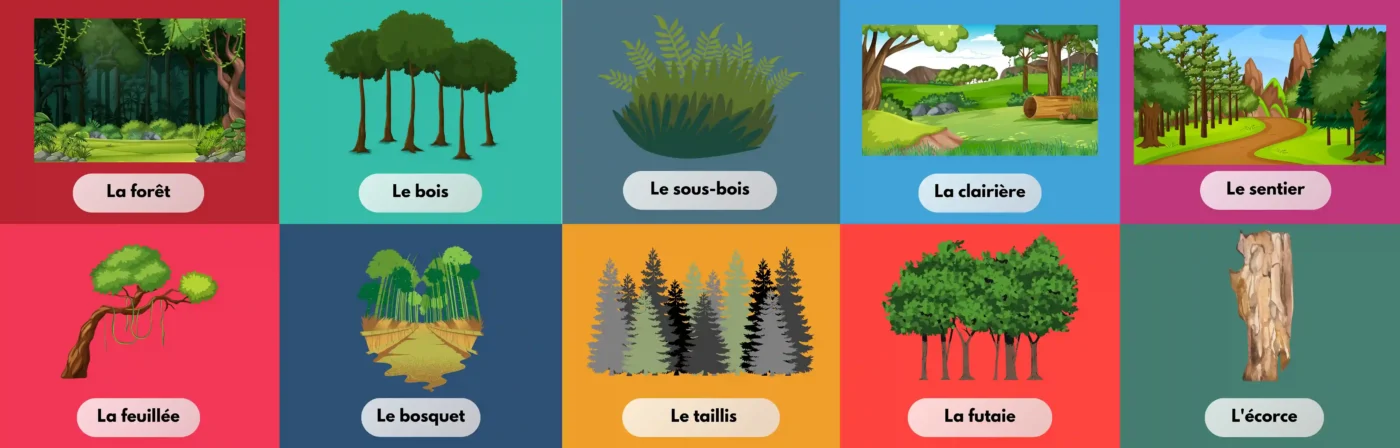
Essential Forest Terms
| French Term | English Translation | Definition | Usage and Context |
|---|---|---|---|
| La forêt | The forest | A large area covered chiefly with trees and undergrowth | “La forêt de Fontainebleau est célèbre pour ses rochers” (The forest of Fontainebleau is famous for its rocks). |
| Le bois | The wood | A smaller, often managed, area of trees | “Le bois de Vincennes est un grand parc urbain” (The wood of Vincennes is a large urban park). |
| Le sous-bois | The undergrowth | The vegetation beneath the forest canopy | “Le sous-bois est dense en été” (The undergrowth is dense in summer). |
| La clairière | The clearing | An open space in a forest | “La clairière est un bon endroit pour pique-niquer” (The clearing is a good place for a picnic). |
| Le sentier | The trail/path | A narrow path or track in a forest | “Le sentier mène au sommet de la colline” (The trail leads to the top of the hill). |
| La feuillée | The leafy canopy | The upper layer of leaves and branches in a forest | “La feuillée offre de l’ombre” (The leafy canopy provides shade). |
| Le bosquet | The grove | A small group of trees | “Le bosquet est planté de chênes” (The grove is planted with oaks). |
| Le taillis | The copse | A small area of closely planted trees | “Le taillis est souvent utilisé pour le bois de chauffage” (The copse is often used for firewood). |
| La futaie | The stand | A group of trees of uniform age and composition | “La futaie de pins est majestueuse” (The stand of pines is majestic). |
| L’écorce | The bark | The protective outer covering of a tree | “L’écorce de l’arbre est rugueuse” (The bark of the tree is rough). |
Describing Woodlands and Trails
| French Term | English Translation | Definition |
|---|---|---|
| Le sous-bois | The undergrowth | The vegetation beneath the forest canopy |
| La clairière | The clearing | An open space in a forest |
| Le sentier | The trail/path | A narrow path or track in a forest |
| La feuillée | The leafy canopy | The upper layer of leaves and branches in a forest |
| Le bosquet | The grove | A small group of trees |
| Le taillis | The copse | A small area of closely planted trees |
| La futaie | The stand | A group of trees of uniform age and composition |
Coastal Features
Coastal features play a significant role in describing France’s diverse and scenic shoreline. Here’s a look at the key vocabulary for these features.
Key Terms for Beaches and Cliffs
| French Term | English Translation | Definition | Usage and Context |
|---|---|---|---|
| La plage | The beach | A sandy or pebbly shore by the sea or a lake | “La plage de Biarritz est très populaire en été.” (Biarritz beach is very popular in summer.) |
| La falaise | The cliff | A steep face of rock and earth | “Les falaises d’Étretat sont impressionnantes.” (The cliffs of Étretat are impressive.) |
| Le sable | The sand | Fine particles of rock found on beaches and deserts | “Le sable est chaud sous les pieds.” (The sand is hot underfoot.) |
| La digue | The dike | A barrier built to prevent flooding or erosion | “La digue protège le port des tempêtes.” (The dike protects the port from storms.) |
| Le rocher | The rock | A naturally occurring solid mineral material | “Le rocher offre une vue splendide.” (The rock offers a splendid view.) |
| Le galet | The pebble | A small, smooth stone found on beaches | “La plage est couverte de galets.” (The beach is covered with pebbles.) |
| La corniche | The cliffside road | A road built along the edge of a cliff | “La corniche offre une vue panoramique sur la mer.” (The cliffside road offers a panoramic view of the sea.) |
| La marée | The tide | The periodic rise and fall of sea levels | “La marée monte rapidement.” (The tide is rising quickly.) |
| L’estran | The foreshore | The part of the shore between high and low water marks | “L’estran est exposé pendant les marées basses.” (The foreshore is exposed during low tides.) |
| Le tombolo | The sandbar | A bar of sand connecting an island to the mainland | “Le tombolo relie l’île au continent.” (The sandbar connects the island to the mainland.) |

Ports, Bays, and Peninsulas
| French Term | English Translation | Definition |
|---|---|---|
| Le port | The port | A place where ships dock and unload |
| La baie | The bay | A broad inlet of the sea where the land curves inward |
| Le golfe | The gulf | A large area of sea partially enclosed by land |
| L’île | The island | A piece of land completely surrounded by water |
| La péninsule | The peninsula | A piece of land almost surrounded by water |
| Le récif | The reef | A ridge of rocks or coral just below or above the surface of the sea |
| La lagune | The lagoon | A shallow body of water separated from the sea by a barrier |
| Le phare | The lighthouse | A tower with a light that guides ships at sea |
| Le quai | The quay | A platform along the edge of a port for loading and unloading |
| Le port de plaisance | The marina | A harbour for pleasure boats and yachts |

Deserts and Arid Regions
Deserts and arid regions offer unique landscapes that are distinct from other terrains. Understanding the vocabulary related to these areas is essential for describing their features.
Vocabulary for Deserts
| French Term | English Translation | Definition | Usage and Context |
|---|---|---|---|
| Le désert | The desert | A barren area with very little precipitation | “Le désert du Sahara est le plus grand désert chaud du monde” (The Sahara Desert is the largest hot desert in the world). |
| La dune | The dune | A mound or ridge of sand formed by the wind | “Les dunes de sable changent de forme avec le vent” (The sand dunes change shape with the wind). |
| Le sable | The sand | Fine particles of rock found in deserts | “Le sable du désert est très fin et chaud” (The sand in the desert is very fine and hot). |
| Le mirage | The mirage | An optical illusion caused by atmospheric conditions | “Un mirage peut apparaître comme un lac lointain” (A mirage can appear like a distant lake). |
| La chaleur | The heat | High temperature typical of desert environments | “La chaleur du désert peut être accablante” (The desert heat can be overwhelming). |
| Le cactus | The cactus | A type of plant adapted to arid conditions | “Les cactus stockent de l’eau pour survivre” (Cacti store water to survive). |
| La sécheresse | The drought | A prolonged period of abnormally low rainfall | “La sécheresse a rendu la terre stérile” (The drought has made the land barren). |
| La tempête de sable | The sandstorm | A strong wind carrying sand particles | “La tempête de sable a obscurci le ciel” (The sandstorm obscured the sky). |
| Le désert rocheux | The rocky desert | A desert area with many rock formations | “Le désert rocheux est parsemé de formations rocheuses” (The rocky desert is dotted with rock formations). |
| La faune | The wildlife | Animals living in desert regions | “La faune du désert est adaptée aux conditions extrêmes” (Desert wildlife is adapted to extreme conditions). |
Describing Dunes and Oases
| French Term | English Translation | Definition |
|---|---|---|
| La dune | The dune | A mound or ridge of sand formed by the wind |
| L’oasis | The oasis | A fertile area in a desert with water sources |
| Le sable | The sand | Fine particles of rock found in deserts |
| La végétation | The vegetation | Plant life in a given area |
| La source | The spring | A natural source of water |
| La palmeraie | The palm grove | An area with many palm trees |
| Le désert de sel | The salt desert | A desert with a surface covered in salt flats |
| La dune mobile | The moving dune | A dune that shifts position due to the wind |
| L’oasis de montagne | The mountain oasis | An oasis located in mountainous regions |
| La croûte de sel | The salt crust | A layer of salt formed on the surface of the desert |

Special Geographic Features
Special geographic features include unique landforms and natural phenomena that add to the diversity of landscapes. Understanding these terms enhances one’s ability to describe and explore these remarkable features.
Unique Terms for Volcanoes and Caves
| French Term | English Translation | Definition | Usage and Context |
|---|---|---|---|
| Le volcan | The volcano | A mountain or hill with a crater through which lava, rock fragments, and gases erupt | “Le volcan de Montserrat est encore actif” (The Montserrat volcano is still active). |
| La grotte | The cave | A natural underground space large enough for a human to enter | “La grotte de Lascaux contient des peintures préhistoriques” (The Lascaux cave contains prehistoric paintings). |
| Le cratère | The crater | A bowl-shaped depression at the top of a volcano formed by eruptions | “Le cratère du volcan est rempli d’eau” (The crater of the volcano is filled with water). |
| La lave | The lava | Molten rock expelled by a volcano during an eruption | “La lave a recouvert une grande partie de l’île” (The lava covered a large part of the island). |
| Le cône | The cone | The conical shape formed by volcanic material around a volcano | “Le cône du volcan est bien formé” (The cone of the volcano is well-formed). |
| La coulée | The flow | The stream of lava flowing from a volcanic eruption | “La coulée de lave a détruit des maisons” (The lava flow destroyed houses). |
| Le magma | The magma | Molten rock beneath the Earth’s surface | “Le magma remonte à la surface lors des éruptions” (The magma rises to the surface during eruptions). |
| La stalactite | The stalactite | A mineral deposit hanging from the ceiling of a cave | “La stalactite a mis des milliers d’années à se former” (The stalactite took thousands of years to form). |
| La stalagmite | The stalagmite | A mineral deposit rising from the floor of a cave | “La stalagmite est souvent un point d’intérêt dans les grottes” (The stalagmite is often a point of interest in caves). |
| La cheminée | The fumarole | An opening in a volcano that emits steam and gases | “La cheminée émet de la vapeur et des gaz” (The fumarole emits steam and gases). |

Gorges, Canyons, and Geysers
| French Term | English Translation | Definition |
|---|---|---|
| La gorge | The gorge | A narrow valley with steep, rocky sides formed by erosion |
| Le canyon | The canyon | A deep ravine between high cliffs or steep slopes, often formed by a river |
| Le geyser | The geyser | A hot spring that periodically erupts with a column of hot water and steam |
| La falaise | The cliff | A steep face of rock and earth |
| La vallée | The valley | A low area between hills or mountains, typically with a river running through it |
| Le plateau | The plateau | An elevated flat area of land |
| La cascade | The waterfall | A place where water flows over a vertical drop |
| L’aven | The sinkhole | A deep, vertical hole in the ground caused by the collapse of a cave roof |
| La roche | The rock | A naturally occurring solid mineral material |
| Le cirque | The cirque | A bowl-shaped valley formed by glacial erosion |

Conclusion
Understanding landscape vocabulary enriches your ability to describe France’s diverse geography, from mountains and valleys to deserts and coastal features. Mastering these terms enhances communication and deepens your appreciation of French landscapes. Keep practising these terms to improve your conversations about French geography. For further exploration of French vocabulary and grammar, check out more on La Forêt French Class.
Frequently Asked Questions
Q1: What is the French word for geography?
Ans: The French word for geography is géographie. This term is used to describe the study of Earth’s landscapes, environments, and the relationships between people and their environments. For more insights into French vocabulary and related topics, explore La Forêt French Class.
Q2: What do the French call Earth?
Ans: In French, Earth is called la Terre. This term refers to the planet we live on, encompassing its land, oceans, and atmosphere.