French Transportation Vocabulary: Complete Guide
Learning transportation vocabulary in French is crucial for effective communication while travelling, studying, or exploring French culture. Whether you are navigating Paris, asking for directions to the airport, or understanding travel-related signs, mastering these words enhances your ability to interact in French-speaking environments.
Key Takeaways
- Know about the transport words such as la voiture (car), le bus (bus), le train (train), & l’avion (plane) makes travel smoother.
- If you familiarise yourself with vehicle parts as like le moteur (engine), la roue (wheel), & le volant (steering wheel) for conversations about cars.
- Learn the biking & motorbiking vocab, such as le vélo (bike), la moto (motorcycle), and le casque (helmet) are good for outdoor enthusiasts.
- Know the public transport basics such as le billet (ticket), la gare (station), and simple phrases like Où se trouve l’arrêt de bus ? (Where is the bus stop?).
- You can also learn related air & water travel words, such as le vol (flight), le ferry (ferry), and handy phrases like Le vol est-il retardé ? (Is the flight delayed?).
- Learn all the vocabs and practice, which can helps you get around confidently in French, also speaking in places while making your travelling experience much easier and fun.
What Are the Types of Vehicles in French?
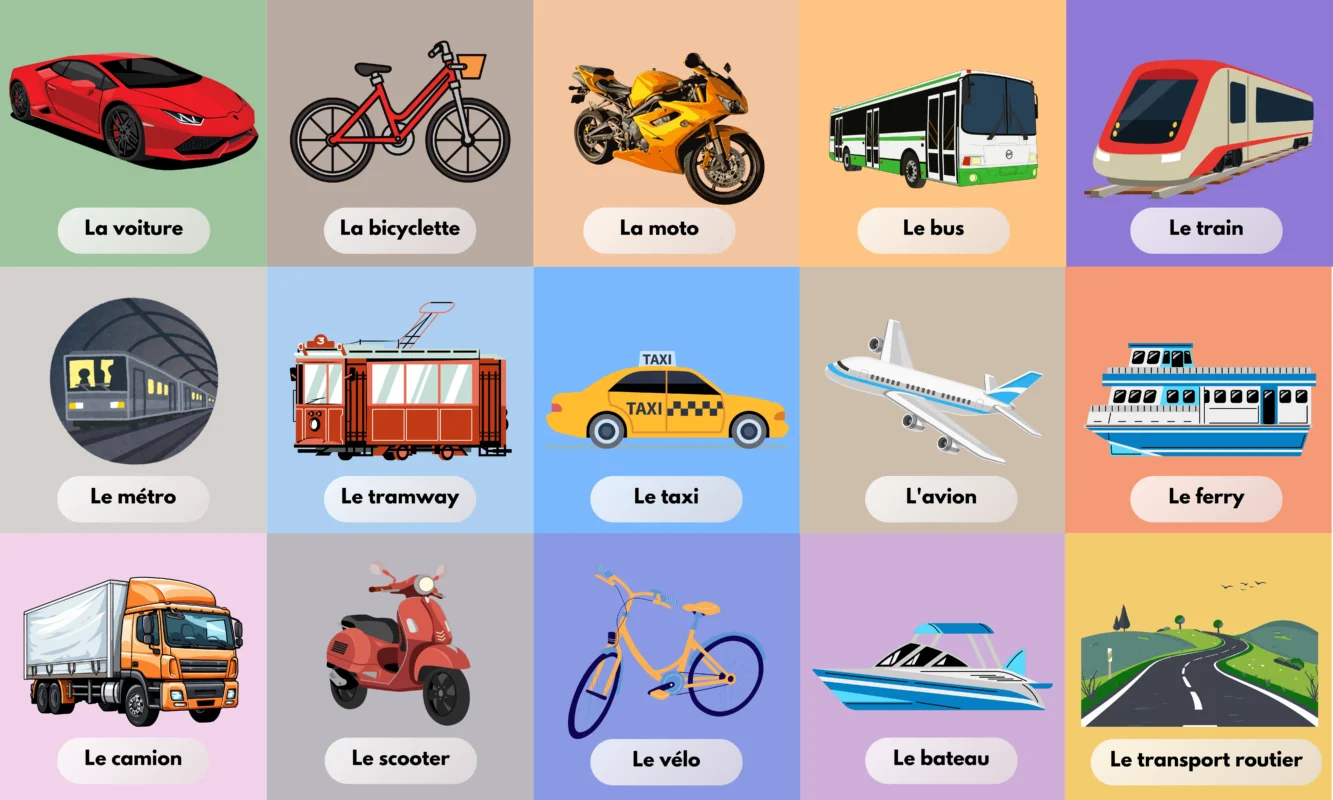
The French classify vehicles according to the particular uses that they have and the kind of setting in which they operate. Whether you are driving in urban traffic or making long journeys through the country, identifying these various kinds of vehículo becomes necessary. The list of French vehicles is quite extensive and varies widely in use.
| French | English |
|---|---|
| La voiture | Car |
| La bicyclette | Bicycle |
| La moto | Motorcycle |
| Le bus | Bus |
| Le train | Train |
| Le métro | Subway |
| Le tramway | Tram |
| Le taxi | Taxi |
| L’avion | Airplane |
| Le ferry | Ferry |
| Le camion | Lorry |
| Le scooter | Scooter |
| Le vélo | Bike |
| Le bateau | Boat |
| Le transport routier | Road (transport) |
Cars Related Vocabulary in French
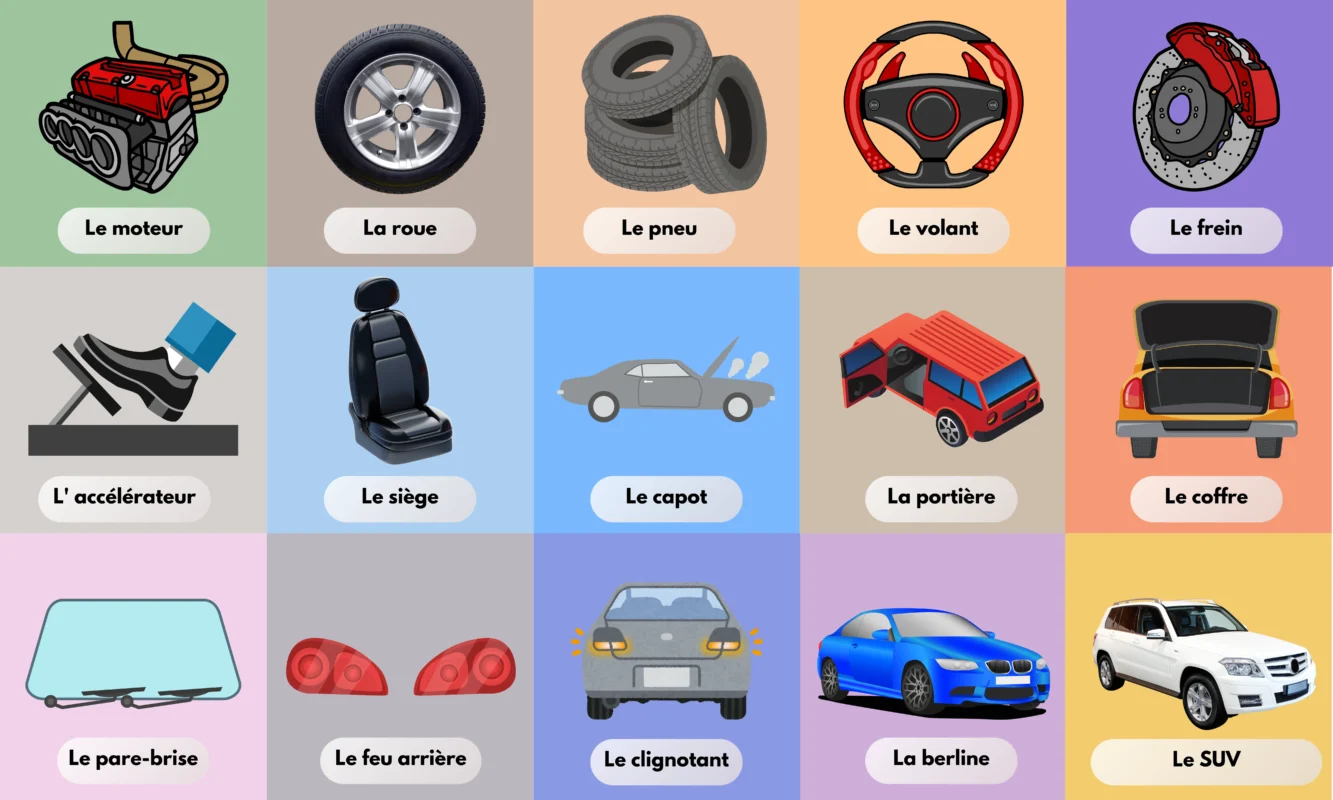
Understanding car-related vocabulary in French is key for anyone discussing or dealing with vehicles in French-speaking areas. Here are some essential terms:
| French | English |
|---|---|
| Le moteur | Engine |
| La roue | Wheel |
| Le pneu | Tyre |
| Le volant | Steering wheel |
| Le frein | Brake |
| L’ accélérateur | Accelerator |
| Le siège | Seat |
| Le capot | Bonnet (Hood) |
| La portière | Door |
| Le coffre | Boot (Trunk) |
| Le pare-brise | Windscreen (Windshield) |
| Le feu arrière | Tail light |
| Le clignotant | Indicator light |
| La berline | Sedan |
| Le SUV | SUV (Sports Utility Vehicle) |
Enhance communication skills by learning French vocabulary for emergencies. Expand your vocabulary for better fluency.
Bicycles and Motorcycles Related Vocabulary in French
Here’s a list of French vocabulary for bicycles and motorcycles, including their parts and different types:
| French | English |
|---|---|
| Le vélo | Bike |
| Le guidon | Handlebars |
| La pédale | Pedal |
| Le frein | Brake |
| La roue | Wheel |
| Le cadre | Frame |
| La selle | Seat |
| La chambre à air | Inner tube |
| Le dérailleur | Gear shift |
| Le garde-boue | Mudguard |
| La moto | Motorcycle |
| Le casque | Helmet |
| Le scooter | Scooter |
| Le VTT | Mountain bike |
| Le vélo de route | Road bike |

Lost for Words? We’ve Got You!
Sign up for our courses and let our expert teachers boost your vocabulary effortlessly!
What Is Public Transportation Vocabulary in French?
When in Paris, the subway and train systems are your best friends. Use this resource to navigate the station:
| French | English |
|---|---|
| Le bus | Bus |
| Le train | Train |
| Le métro | Subway |
| Le tramway | Tram |
| La gare | Station |
| L’arrêt | Stop |
| Le billet | Ticket |
| Le pass | Pass |
| Le quai | Platform |
| Le RER | Regional train |
| La correspondance | Connection |
| Descendre | Alight (Get off) |
| Monter | Board (Get on) |
| Le voyage | Journey |
| La ligne | Line |

Enhance your French skills with essential French technology vocabulary to navigate the digital world confidently.
What Is Air and Water Transportation Vocabulary in French?
Navigating the airport or a boat dock requires specific French transportation vocabulary. Here’s a guide to French vocabulary for air and water transport, including key terms and phrases:
| French | English |
|---|---|
| L’avion | Airplane |
| L’aéroport | Airport |
| Le vol | Flight |
| Le passager | Passenger |
| L’enregistrement | Check-in |
| La piste | Runway |
| La porte d’embarquement | Boarding gate |
| Le bateau | Boat |
| Le navire | Ship |
| Le port | Port |
| Le quai | Quay |
| Le ferry | Ferry |
| La cabine | Cabin |
| L’équipage | Crew |
| Le débarquement | Disembarkation |

What Is Essential Transportation Vocabulary in French?
It is important to learn les transports if you want to get around in any French-speaking region confidently. This article will provide you with all necessary vocabulary related to roads, railways, aircrafts, and ships. You will be taught how to describe vehicle parts, the functioning of public transport, and useful travel expressions.
Examples of Transportation in French:
- Le train – Train
- L’avion – Airplane
- La voiture – Car
- Le vélo – Bicycle
- Le métro – Subway / underground railway
How Do You Ask for Directions in French for Transportation?
To navigate through the French-speaking country, there are special phrases to use when interacting with the local people or transit workers. Knowing how to ask about the stations, stops, and even the particular platform that you have to board can help you get to your destination easily. Here are some important phrases and sentences on how to ask directions using the transit system.
Vocabulary for Asking Directions for Transportation:
- Où est… ? – Where is… ?
- La direction – The direction
- Le plan – The map
- À gauche – To the left
- À droite – To the right
- Tout droit – Straight ahead
- Le guichet – The ticket office
- L’entrée – The entrance
- La sortie – The exit
- Le terminus – The last stop
- Le plan du métro – The subway map
- Le panneau – The sign
- L’itinéraire – The route
- Proche – Nearby
- Loin – Far
Common Questions for Travelers:
- Où se trouve l’arrêt de bus le plus proche ? (Where is the nearest bus stop?)
- Comment aller à la gare Saint-Lazare ? (How do I get to Saint-Lazare station?)
- Quel train va vers le centre-ville ? (Which train goes toward the city center?)
- C’est à quelle distance à pied ? (How far is it on foot?)
- Où est la bouche de métro ? (Where is the metro entrance?)
- Pardon, est-ce que ce bus va au musée ? (Excuse me, does this bus go to the museum?)
How Do You Buy or Get a Ticket in French for Transportation?
The purchase of transportation documents represents the basic stage of your trip. Either you buy the ticket from a self-service terminal or from a person working at the guichet, knowledge of the proper vocabulary regarding kinds of tickets will help you to purchase the appropriate one and not to have to pay a fine.
Vocabulary for Buying a Ticket:
- Un billet – A ticket (usually for trains or planes)
- Un ticket – A ticket (usually for the bus or metro)
- Un aller simple – A one-way ticket
- Un aller-retour – A round-trip ticket
- Un carnet – A pack of tickets (usually 10)
- Le tarif réduit – The reduced fare
Common Phrases for buying a ticket:
- Je voudrais acheter un billet pour Versaille, s’il vous plaît. (I would like a single ticket for Versailles.)
- Est-ce que je peux payer par carte bancaire ? (Can I pay by credit card?)
- Je voudrais un abonnement mensuel. (I would like a monthly pass.)
- Où sont les automates pour les tickets ? (Where are the ticket machines?)
- Un billet plein tarif, s’il vous plaît. (One full-fare ticket, please.)
- Est-ce que ce ticket est valable pour le bus et le métro ? (Is this ticket valid for the bus and the subway?)
How Do You Talk About Travel Time in French?
It’s crucial to use terms related to schedules and lengths of time if you want to travel without any problems. This knowledge can help you find out about your departure time, approximate your arrival, and know how much time your journey will take.
Vocabulary for Talking about Time:
- L’heure de départ – Departure time
- L’heure d’arrivée – Arrival time
- La durée – The duration
- En retard – Late/Delayed
- À l’heure – On time
Common Phrases for Travel Time:
- Combien de temps dure le trajet ? (How long does the trip take?)
- Le train a dix minutes de retard. (The train is ten minutes late.)
- À quelle heure est l’arrivée à Paris ? (What time is the arrival in Paris?)
- Le vol est-il à l’heure ? (Is the flight on time?)
- Il y a un train toutes les quinze minutes. (There is a train every fifteen minutes.)
- Le voyage va durer environ trois heures. (The journey will last about three hours.)
How Do You Get Around the Metro in French?
Successfully using the métro involves knowledge of particular underground signs and metro transportation. To be able to use the métro effectively, it is important to know how to recognize lines, connections, and proper exits. In places such as Paris, it is crucial to understand the logic of navigating the city underground without getting lost in its vast underground tunnels.
Vocabulary for Metro:
- La station de métro – The metro station
- La ligne – The line
- Le plan du réseau – The network map
- La correspondance – The connection/transfer
- Le quai – The platform
- Le portillon – The ticket gate
- La rame – The metro train
- La direction – The direction (destination)
- La sortie – The exit
- Le haut-parleur – The loudspeaker
- L’escalier mécanique – The escalator
- Le composteur – The ticket validator
- Le plan de quartier – The local area map
Common Phrases for Metro Transport:
- Je dois prendre la ligne quatre vers Châtelet. (I need to take line four toward Châtelet.)
- Où est la correspondance pour la ligne douze ? (Where is the transfer for line twelve?)
- Faites attention à la marche en descendant. (Please mind the gap when getting off.)
- Le prochain métro arrive dans deux minutes. (The next metro arrives in two minutes.)
- Il faut valider votre ticket avant d’entrer. (You must validate your ticket before entering.)
- Est-ce que cette rame s’arrête à Montparnasse ? (Does this train stop at Montparnasse?)
How Do You Talk About Travelling by Car in French?
The discussion about traveling by car includes terminology related to the automobile itself, driving, and the road infrastructure. It is important to learn this terminology in order to be able to travel on French autoroutes or even on urban roads, either driving or just riding en voiture.
Vocabulary for Travelling by Car:
- Le conducteur – The driver
- Le passager – The passenger
- Le permis de conduire – The driver’s license
- La ceinture de sécurité – The seatbelt
- Le tableau de bord – The dashboard
- Le rétroviseur – The rearview mirror
- Le phare – The headlight
- Le pare-chocs – The bumper
- Le réservoir – The fuel tank
- L’essence – Petrol/Gasoline
- Le gazole – Diesel
- La station-service – The gas station
- Le parking – The parking lot
- Le stationnement – The parking (act of)
- L’autoroute – The highway/motorway
- Le péage – The toll booth
- Le feu rouge – The red light
- Le panneau de signalisation – The road sign
- L’embouteillage – The traffic jam
- Le détour – The detour
Common Phrases for Travelling by Car:
- Je dois faire le plein d’essence avant de partir. (I need to fill up the tank before leaving.)
- Attachez votre ceinture de sécurité, s’il vous plaît. (Fasten your seatbelt, please.)
- Il y a beaucoup d’embouteillages à cette heure-ci. (There is a lot of traffic at this hour.)
- Où se trouve le parking le plus proche ? (Where is the nearest parking lot?)
- Combien coûte le péage pour aller à Nice ? (How much is the toll to go to Nice?)
- Nous nous sommes garés juste devant le musée. (We parked right in front of the museum.)
How Do You Use Bus Transportation Vocabulary in French?
It is important to have specific vocabulary when moving around the city bus system because it will allow you to easily use public transportation, speak with the driver (le chauffeur), and know the distinction between local travel and traveling through different parts of France.
Vocabulary for Bus Transportation:
- L’arrêt de bus – The bus stop
- Le chauffeur – The driver
- L’autobus – The city bus
- L’autocar – The long-distance coach
- Le ticket de bus – The bus ticket
- Le numéro de ligne – The line number
- L’horaire – The schedule/timetable
- La validation – The validation (of a ticket)
- Demande d’arrêt – Stop request
- Le couloir de bus – The bus lane
Common Phrases for Bus Transportation:
- Est-ce que ce bus s’arrête à la place de la Concorde ? (Does this bus stop at Place de la Concorde?)
- Je voudrais acheter un ticket auprès du chauffeur. (I would like to buy a ticket from the driver.)
- N’oubliez pas de valider votre titre de transport. (Don’t forget to validate your travel pass.)
- Il faut appuyer sur le bouton pour demander l’arrêt. (You must press the button to request a stop.)
- À quelle heure passe le prochain bus pour l’aéroport ? (What time is the next bus to the airport?)
- Le bus est complet, nous devons attendre le suivant. (The bus is full; we have to wait for the next one.)
How Do You Talk About Traveling by Boat in French?
The terminology used to describe different kinds of ships, ports, and the journey at sea is unique when speaking about maritime voyages. Irrespective of whether you plan to go for a leisurely river cruise or a huge ferry across the English Channel, knowing some of these terms will be helpful.
Vocabulary for Boat:
- Le bateau – The boat
- Le navire – The ship
- Le ferry – The ferry
- Le port – The port/harbor
- Le quai – The quay/pier
- Le pont – The deck
- La cabine – The cabin
- Le gilet de sauvetage – The life jacket
- L’équipage – The crew
- Le mal de mer – Seasickness
Common Phrases for Traveling by Boat:
- À quelle heure est l’embarquement pour le ferry ? (What time is boarding for the ferry?)
- Le bateau part du quai numéro trois. (The boat departs from pier number three.)
- Avez-vous des médicaments contre le mal de mer ? (Do you have any medicine for seasickness?)
- Nous allons faire une croisière sur la Seine. (We are going to take a cruise on the Seine.)
- Où se trouvent les gilets de sauvetage ? (Where are the life jackets located?)
- Le capitaine et l’équipage vous souhaitent la bienvenue. (The captain and the crew welcome you.)
How Do You Talk About Air Travel in French?
The airport is a place where we need certain vocabularies in order to deal with check-in, security screening, and boarding processes without hassle. Knowledge of those words enables us to catch announcements, find our gate and talk to airport employees so that we can have a pleasant experience there.
Vocabulary for Air Travel:
- L’avion – The airplane
- L’aéroport – The airport
- Le vol – The flight
- La compagnie aérienne – The airline
- La carte d’embarquement – The boarding pass
- Le billet d’avion – The plane ticket
- Le bagage à main – The carry-on luggage
- La valise – The suitcase
- Le décollage – The takeoff
- L’atterrissage – The landing
- L’équipage – The crew
- Le hublot – The window (on a plane)
Common Phrases for Air Travel:
- À quelle heure commence l’enregistrement pour le vol vers Paris ? (What time does check-in start for the flight to Paris?)
- Veuillez présenter votre passeport et votre carte d’embarquement. (Please present your passport and your boarding pass.)
- Où se trouve la porte d’embarquement numéro dix ? (Where is boarding gate number ten?)
- Le vol est retardé de trente minutes à cause de la météo. (The flight is delayed by thirty minutes due to the weather.)
- Avez-vous des bagages à enregistrer en soute ? (Do you have any luggage to check into the hold?)
- Le départ est prévu à dix heures. (The departure is at ten o’clock.)
- Veuillez attacher votre ceinture pour le décollage. (Please fasten your seatbelt for takeoff.)
How Do You Talk About Train Travel in French?
The train network is the lifeblood of France’s transportation system, connecting big cities by means of the TGV. It is necessary to learn the vocabulary that is unique to trains in order to navigate the station, understand announcements at the platform, and get on the right train.
Vocabulary for Train Travel:
- La gare – The train station
- Le quai – The platform
- Le contrôleur – The ticket inspector
- La voie – The track
- Le wagon / La voiture – The train carriage
- Le TGV – High-speed train (Train à Grande Vitesse)
Common Phrases for Train Travel:
- Le train en provenance de Lyon arrive en voie A. (The train coming from Lyon is arriving on track A.)
- N’oubliez pas de composter votre billet avant de monter. (Don’t forget to validate your ticket before boarding.)
- Où se trouve la voiture numéro onze, s’il vous plaît ? (Where is carriage number eleven, please?)
- Le train direct pour Marseille part du quai numéro deux. (The direct train to Marseille departs from platform number two.)
- Est-ce que je dois changer de train à Paris ? (Do I have to change trains in Paris?)
- Attention au départ, le train va démarrer. (Watch out for departure, the train is about to start.)
How Do You Talk About Two-Wheel Transportation in French?
Travelling through the cities or picturesque roads by cycling is an easy and convenient means of transportation in France. Being aware of the particular vocabulary related to bicycles, motorcycles, and protective clothing enables you to rent the necessary gear, talk about maintenance, and choose the correct route.
Vocabulary for Two-Wheel Transportation:
- Le vélo – The bicycle
- La moto – The motorcycle
- Le casque – The helmet
- La piste cyclable – The cycle lane/path
- Le cadenas – The bike lock
- La pédale – The pedal
Common Phrases for Two-Wheel Transportation:
- Où puis-je louer un vélo pour la journée ? (Where can I rent a bike for the day?)
- Il est obligatoire de porter un casque à moto. (It is mandatory to wear a helmet on a motorcycle.)
- Faites attention aux voitures sur la piste cyclable. (Pay attention to cars on the cycle lane.)
- Mon vélo a un pneu dégonflé, je dois le réparer. (My bike has a flat tire; I need to fix it.)
- Est-ce qu’il y a un parking pour les deux-roues ici ? (Is there a parking area for two-wheelers here?)
- Nous allons faire une balade à vélo le long du canal. (We are going to take a bike ride along the canal.)
Useful Phrases for Transportation in French
Navigating a new city or country becomes much easier when you can communicate your needs quick and clearly. Here are the most essential French phrases for transportation, organized by category, with their English translations:
General Navigation & Directions
- Où se trouve l’arrêt de bus ? – Where is the bus stop?
- Pouvez-vous me dire où est la gare ? – Can you tell me where the train station is?
- Je suis perdu(e), pouvez-vous m’aider ? – I am lost, can you help me?
- Puis-je avoir une carte de transport, s’il vous plaît ? – May I have a transport map, please?
Tickets & Fares
- Je voudrais acheter un billet, s’il vous plaît. – I would like to buy a ticket, please.
- Je voudrais un billet aller-retour, s’il vous plaît. – I would like a return ticket, please.
- Combien coûte un billet pour Paris ? – How much is a ticket to Paris?
- Où peut-on acheter les tickets ? – Where can one buy tickets?
Trains & Metro (Subway)
- À quelle heure part le prochain train ? – What time does the next train leave?
- Est-ce que ce train va à Lyon ? – Does this train go to Lyon?
- Quelle est la prochaine station ? – What is the next station?
- Je dois changer de ligne ici ? – Do I need to change lines here?
- Je dois descendre au prochain arrêt. – I need to get off at the next stop.
Air Travel & Security
- Le vol est-il retardé ? – Is the flight delayed?
- Où est le contrôle des passeports ? – Where is passport control?
- Je voudrais un siège près du hublot. – I would like a window seat.
- À quelle porte est l’embarquement ? – At which gate is boarding?
Pro-Tip:
If you need help, then always begin your sentence with “Bonjour” and end it with “s’il vous plaît” (please). The French culture has such an effect that even adding these simple changes in your sentence can make you more acceptable to the transport officials!
Knowing transport vocabulary in French is vital for smooth travel and effective communication. Practising these terms can greatly enhance your travel experiences and interactions in French-speaking regions. For further improvement, consider exploring La Forêt French Class to expand your vocabulary and refine your French skills.
Frequently Asked Questions
Q1. What is the feminine form of vehicle in French?
Ans: In French, the word “véhicule” is masculine, so it doesn’t have a feminine form.
Q2. What is taxi in French?
Ans: The word for “taxi” in French is also “taxi.” It’s a straightforward term that remains the same in both languages.
Q3. What Are the Types of Transportation in French?
Ans: French transportation is categorized into les transports terrestres (land), les transports maritimes (water), and les transports aériens (air). Common types include le train, l’avion, and le bateau, providing diverse options for domestic and international travel across France.
Q4.What Are the Names of Vans and Vehicles in French?
Ans: In French, a van is typically called une camionnette or un van. General vehicles are referred to as les véhicules, which includes un camion (truck), un autocar (long-distance coach), and un break (station wagon) for various utility purposes.
Q5. How Do You Say “Car” in French, and Is It Masculine or Feminine?
Ans: The word for “car” in French is la voiture. Grammatically, it is a feminine noun. Alternatively, you may hear the informal term l’auto, which is also feminine, though la voiture remains the standard term in formal conversation.
Q6. What Are the Different Modes of Transportation in French?
Ans: The primary modes of transportation include le transport public (public transit like le métro), le transport privé (personal cars), and les modes actifs (active travel like le vélo). Each mode is essential for navigating urban and rural landscapes efficiently.