Shapes in French: French Shapes Vocabulary
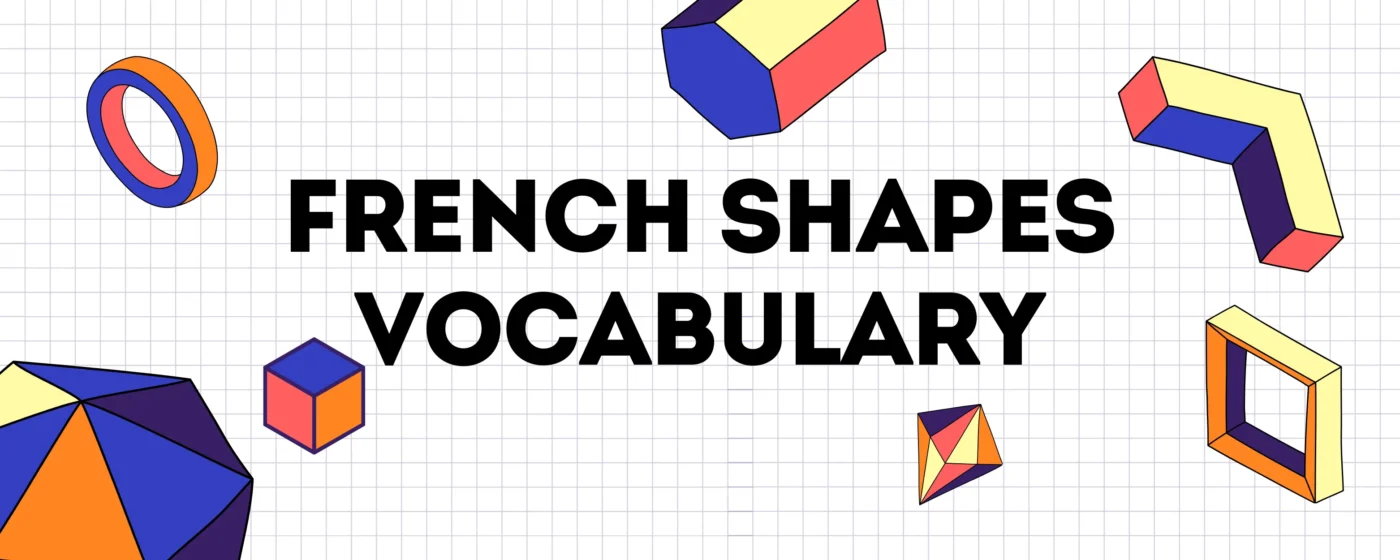
Learning shapes in French is a lot more than just memorizing a vocabulary list. It’s actually a fundamental step on the road to true fluency and really feeling like you’re getting the hang of the language. And to be honest, knowing what these terms mean in everyday life can be a real lifesaver. Want to accurately describe objects, give super precise directions, or even just grasp the basics of geometry? Knowing your way around basic shapes is a no-brainer.
Shapes in French: Common Shapes and Their Meanings
Learning about shapes, called “les formes” in French, is an important aspect of building your descriptive vocabulary.
Let’s begin with some basic 2D (two-dimensional) shapes
Here is a list of basic 2D shapes in French:
- Un cercle (a circle)For example: a button
- Un carré (a square)For example: a chessboard square
- Un triangle (a triangle)For example: a slice of pizza
- Un rectangle (a rectangle)For example: a book
- Un ovale (an oval)For example: an egg
3D (three-dimensional) shapes in French are often called “les solides”.
Let’s look at some of the most common 3D shapes in French:
- Une sphère (a sphere):For example: a globe
- Un cube (a cube)For example: a dice
- Un cylindre (a cylinder)For example: a can of soda
- Un cône (a cone)For example: an icecream cone
Shapes come up all the time in everyday French conversations. You’ll hear them when people are describing objects. For example: “La table est ronde” . Knowing these terms in French is a must for giving directions. For instance: “Tournez à droite après le bâtiment rectangulaire” . Grasping these terms will let you communicate in French with more precision and depth.
Basic 2D Shapes in French
Essential 2D Shapes
| French Shape | Pronunciation | English Equivalent | Example | Translation |
| Le cercle | luh sehr-kluh | Circle | La roue est un cercle. | The wheel is a circle. |
| Le carré | luh kah-ray | Square | Cette boîte est carrée. | This box is square. |
| Le rectangle | luh rek-tahng-gluh | Rectangle | La porte est un rectangle. | The door is a rectangle. |
| Le triangle | luh tree-ahng-gluh | Triangle | Le panneau routier est un triangle. | The road sign is a triangle. |
| L’ovale | loh-val | Oval | L’œuf a une forme ovale. | The egg has an oval shape. |
| Le losange | luh loh-zahngzh | Rhombus/Diamond | Le cerf-volant est en forme de losange. | The kite is diamond-shaped. |
| Le trapèze | luh trah-pez | Trapezoid | La base de ce sac est un trapèze. | The base of this bag is a trapezoid. |
| L’étoile | leh-twahl | Star | J’ai dessiné une étoile. | I drew a star. |
| Le cœur | luh ker | Heart | Ce coussin est en forme de cœur. | This cushion is heart-shaped. |
| Le croissant | luh krwah-sahng | Crescent | La lune est un croissant ce soir. | The moon is a crescent tonight. |
Want to describe your home in French more naturally? Check out our complete guide on French Vocabulary for Furniture and learn practical words for living rooms, bedrooms, and more.
Advanced 2D Shapes in French
Less Common but Useful Shapes
| Shape | English Equivalent | Fun Fact | Translation |
| Le Losange | Rhombus | Un losange est un quadrilatère dont les quatre côtés ont la même longueur. | A rhombus is a quadrilateral whose four sides have the same length. |
| Le Trapèze | Trapezoid | Le trapèze est un quadrilatère qui a au moins une paire de côtés parallèles. | A trapezoid is a quadrilateral with at least one pair of parallel sides. |
| Le Pentagone | Pentagon | Le Pentagone, le siège du département de la Défense des États-Unis, est le plus grand immeuble de bureaux du monde. | The Pentagon, headquarters of the United States Department of Defense, is the largest office building in the world. |
| L’Hexagone | Hexagon | La France est souvent appelée “L’Hexagone” en raison de sa forme géographique distincte. | France is often called “L’Hexagone” (The Hexagon) due to its distinct geographical shape. |
| L’Octagone | Octogon | Une cage de MMA (Mixed Martial Arts) est souvent de forme octogonale pour des raisons de sécurité. | An MMA (Mixed Martial Arts) cage is often octagonal in shape for safety reasons. |
Lost for Words? We’ve Got You!
Sign up for our courses and let our expert teachers boost your vocabulary effortlessly!
3D Shapes in French
Common 3D Shapes
| Shape | Translation | Real-Life Applications | Example |
| La sphère | The Sphere | Les balles, les planètes, les bulles de savon, les globes terrestres. Forme parfaite pour le mouvement et l’emballage efficace. | Une sphère est souvent utilisée pour fabriquer des jouets comme des balles. (A sphere is often used to make toys like balls.) |
| Le cube | The Cube | Les dés, les boîtes d’emballage, les blocs de construction, certains meubles. Stabilité, empilement facile, volumes réguliers. | J’ai mis mes livres dans une boîte en forme de cube. (I put my books in a cube-shaped box.) |
| Le cylindre | The Cylinder | Les canettes, les tuyaux, les batteries, les rouleaux à pâtisserie. Idéal pour le stockage de liquides, le transport, et le roulement. | Cette boisson est vendue dans une canette en cylindre. (This drink is sold in a cylinder can.) |
| Le cône | The Cone | Les cônes de crème glacée, les chapeaux de fête, les entonnoirs, les signaux routiers. Utile pour la concentration ou la dispersion, et la signalisation. | Mon enfant adore manger une glace dans un cône croustillant. (My child loves to eat ice cream in a crispy cone.) |
| Le prisme | The Prism | Les briques, les bâtiments, les livres, les boîtes de céréales. Offre une grande stabilité, un grand volume, et une construction modulaire. | Beaucoup de bâtiments modernes ont une forme de prisme. (Many modern buildings have a prism shape.) |
Improve your French vocabulary by exploring our blog on Utensils in French, where you’ll learn the names of common kitchen tools, cooking equipment, and dining cutlery.
Fun Ways to Remember French Shapes
Here are some fun & simple tips to help you learn French shapes.
1. Flashcards can be a real lifesaver
On the front, stick the French term (like la sphère), on the back you can put the English translation and a small doodle of the shape. You can schedule flashcard review sessions over the week or at specific times to keep things fresh. The more you review, the quicker you’ll get it!
2. Labelling your household objects is also a great way to learn
Stick a little note on a ball (la sphère), a box (le cube) or a can (le cylindre) around the house. This constant visual reminder will not only reinforce the vocabulary but also make learning feel more natural.
3. Learning from children’s books is also an effective way to pick up the words
These books are written in super simple language, and use repetition, along with fun illustrations, to help you pick up new words like shape names in a fun story. Look for titles that specifically introduce basic shapes in French.
4. Making learning a game can be a blast
Online apps, physical shape games, or even “I spy” in French focusing on shapes can be scheduled at different times during the week to help you remember. These types of games make learning fun and interactive!
Learning classroom words is essential for beginners. Check out this helpful guide on French School Vocabulary to discover common school terms used in everyday French learning.
Summary
Ready to take your French learning further? Have a look at La Forêt French Class for some more structured lessons and interactive exercises to practice your vocabulary & fluency. Cheers for reading, and we hope you enjoyed this lesson on French shapes. We hope you keep exploring more and more French shapes and resources as you progress on your learning journey.
Frequently Asked Questions
Q1. Which French shape word might make you think of a fancy dance?
Ans: “Le losange” (rhombus or diamond shape). While it’s a technical term, its sound is quite elegant & almost like a step in a dance. It’s a bit more unique than “square” or “circle”.
Q2. Ever wonder why “sphere” in French (“la sphère”) uses “la” instead of “le”?
Ans: While many 3D french shapes (such as a cube, a cylinder, a cone) have masculine forms, “a sphere” is actually feminine. Keeping this one tricky exception in mind will help you get a feel for French noun genders early on.