10 Best Wineries & Vineyards You Must Visit in France
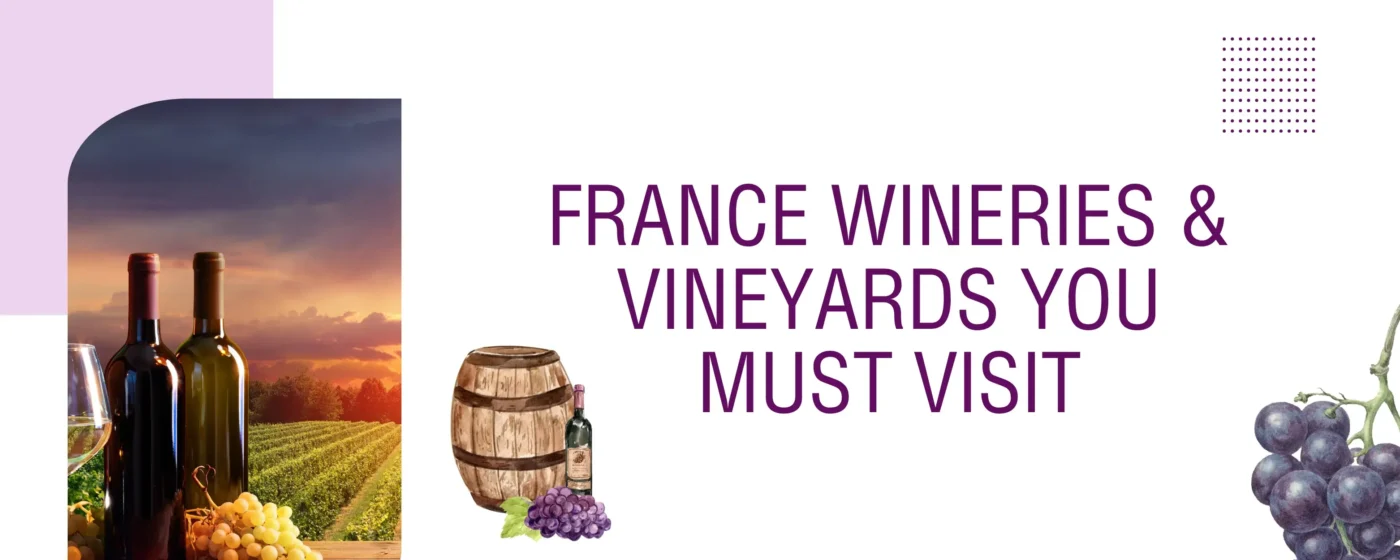
Perhaps we can presume that only France has the superpower to combine geography, history and grape variety quite so precisely that it becomes the best in it, holding around 750,000 hectares under vine spread across a dozen distinct regions.
This blog covers what makes each major wine region special, ten wineries worth planning a trip around, a simple explanation of terroir, and practical tips to plan a tasting tour. Whether you’re a curious amateur or already know your Médoc from your Margaux, there’s something here worth bookmarking and highlighting.
Key Takeaways
- French vineyards cover iconic regions like Bordeaux, Burgundy, Provence and the Loire Valley, each offering unique landscapes, traditions and beautifully distinct wine styles.
- Popular French grapes include Merlot, Cabernet Sauvignon, Pinot Noir and Chardonnay, allowing learners to appreciate the variety and character in every region.
- The idea of terroir highlights how soil, climate and environment shape every bottle, giving French wines their identity and memorable taste experience.
- Exploring vineyards during quieter seasons offers relaxed tastings, scenic walks and a deeper understanding of winemaking without overwhelming tourist crowds.
Wine Regions of France
France’s wine map is really a map of climates and soils, and each region below is known for a distinct style because of it.
Bordeaux
Bordeaux is renowned to be largest wine region in France in terms of fine wine production. Found in southwest France and is divided by the Gironde estuary into the Left Bank (Médoc and Graves) and the Right Bank (Saint-Émilion and Pomerol). The climate in this area is temperate and oceanic, which, together with the diversity of soils in this region, is favorable for growing red grape varieties.
In particular, they include cabernet sauvignon , merlot , and cabernet franc. Merlot is central to the Right Bank, providing wines with good fruitiness and softness. Cabernet sauvignon is the most widespread grape variety in Bordeaux and gives the wines their typical structure and hardness.
Cabernet franc is often used to varietally enhance the bouquet of Bordeaux wines. In addition to red varieties, sauternes is famous for its sweet white wines. This region possesses a unique history and has developed a brand that has attracted global attention, including but not limited only to investors
Burgundy
The French region of Burgundy, or Bourgogne, is located to the north of the Côte d’Or. The natural conditions there are characterized by a cool continental climate. The wines produced in Burgundy are elegant rather than powerful, and a patchwork of limestone and marl, which varies from row to row, accounts for this.
The region is famous for two grapes, Pinot Noir and Chardonnay. The former grows relatively difficult to grow, but it produces wines of exceptional quality. As for Chardonnay, the grape varies from light and refreshing in Chablis to full bodied and ripe in the south.
Finally, the French region is known for its family-l owned wineries and a hierarchy of vineyards, which includes villages, premier crus, and grand crus.
Provence
French wine becomes pink in Provence. The Mistral wind, which guards the vines to retain it’s dryness in order to prevent disease, and the long, dry Mediterranean summers make this country perfect for rosé production. The heavy lifting is done by Grenache, Cinsault, and Syrah, which are thereafter blended into a variety of styles, from richer, fruitier ones to pale, barely there ones.
Even in scorching heat, limestone flecked, stony soils retain their freshness. In all honesty, Provence is more about the landscape hilltop villages, lavender meadows, and vineyards that make good lunch spots than it is about the estates themselves.
The Loire Valley
Loire’s climatic variance is known across seas as it is much more than what a territory this size has any right to. It stretches from the Atlantic almost to the center of France. Cooler, frequently maritime weather favors crisp whites over lush ones. Sancerre, Pouilly-Fumé, and the east are all owned by Sauvignon Blanc, which leads to a zesty, mineral wines. Chenin Blanc, which can range from bone-dry to appropriately sweet depending on the vintage, takes over further west, in Vouvray and Anjou.
Additionally, Cabernet Franc is examined, primarily in the Chinon region. The Loire, known as the “Garden of France” because of its châteaux, is actually one of the simpler places to visit on a casual basis: flat-ish bicycle routes, cellars that don’t require six weeks’ notice, and tastings that won’t break the bank.
10 Best Wineries and Vineyards to Visit in France
These ten estates were chosen to talk about in this blog for what they show visitors about French winemaking, not just for their price tags.
1. Château Margaux
Region: Bordeaux, Margaux
We learn something new every day , for today here’s one. The Château Margaux was one of four original First Growths and has been producing wine on this site since at least the 16th century. Built in the 1810s, the neoclassical château is just as recognizable as the wine.
Together with Pavillon Blanc, a lesser white wine, its grand vin is a Cabernet Sauvignon-dominated mix renowned for structure and lengthy aging potential. Do you know what all is usually included on prearranged visits?
The cellars, the estate’s art collection and a tasting of recent releases. One would even say that seeing this firsthand, how the 1855 classification is still used in a single glass would be worth it.
2. Château Cheval Blanc
Region: Saint-Émilion, Bordeaux
This estate was created in 1832 when a portion of land was taken from the Château Figeac vineyards. Cheval Blanc located on an unusual gravel and sand soil near the Pomerol border.
Ranked Premier Grand Cru Classé A in the 1955 Saint Émilion classification, it produces a rare near even blend of Cabernet Franc and Merlot, a departure from Bordeaux’s usual Merlot- or Cabernet Sauvignon-led wines.
Since 1998 the estate has been owned by Bernard Arnault and Albert Frère, who commissioned a striking new cellar from architect Christian de Portzamparc, completed in 2011. Private tours cover the modern winemaking facility and historic grounds.
3. Domaine de la Romanée-Conti
Region: Vosne-Romanée, Burgundy
DRC farms some of Burgundy’s smallest and most sought-after grand cru plots, several no larger than a few hectares, under the same family’s stewardship since the 18th century and strict biodynamic farming across all its holdings. Its Pinot Noir and small amount of Chardonnay are prized for elegance and a distinct sense of place rather than power, and bottles routinely sell for thousands of euros at auction.
Public visits are extremely limited and usually arranged only through the trade. Even a distant view of the walled Romanée-Conti plot from the village road explains why this tiny vineyard commands such reverence.
4. Clos de Vougeot
Region: Vougeot and Burgundy
Created by Cistercian monks from the Abbey of Cîteaux between the 12th and 14th centuries, Clos de Vougeot is the largest single grand cru vineyard in the Côte de Nuits, spanning slightly over 50 hectares. It was surrounded by a stone wall in 1336.
Approximately eighty proprietors currently share the vineyard, which is solely planted to Pinot Noir. Since 1934, the Confrères des Chevaliers du Tastevin, a Burgundian wine brotherhood, has called the Renaissance era château at its heart home. Visitors can get a unique glimpse at how monastic winemaking influenced the area by exploring the château and its 12th-century wine press.
5. Château d’Yquem
Region: Sauternes, Bordeaux
Château d’Yquem has an unbroken winemaking history back to the 16th century and was the only estate awarded Premier Cru Supérieur, a rank above every other château, in the 1855 classification.
Its wine comes from Sémillon and Sauvignon Blanc grapes left on the vine until noble rot concentrates their sugars and flavour, producing a rich, honeyed sweet wine capable of ageing for decades. Harvesting happens in several passes, sometimes grape by grape, which is part of why yields are so low.
6. Château Smith Haut Lafitte
Region: Pessac-Léognan, Bordeaux
Château Smith Haut Lafitte has grown vines since 1365 and proudly shares it’s name with Georges Smith, the Scottish merchant who bought the estate in the 18th century. Daniel and Florence Cathiard, who also founded the Caudalie skincare brand, acquired the run down property in 1990 and rebuilt its reputation, investing in one of only three private cooperages in Bordeaux.
The estate produces both red and white wine, a rarity among top Bordeaux châteaux, with reds built on Cabernet Sauvignon and Merlot. Tours cover the vineyard, cellars and cooperage, and the on-site spa makes it one of Bordeaux’s few genuine overnight wine destinations.
7. Maison Guigal
Region: Ampuis, Northern Rhône Valley
Étienne Guigal who founded in 1946, worked at the nearby Vidal-Fleury house from the age of fourteen, Maison Guigal is now run by the family’s third generation from the 12th-century Château d’Ampuis. The house is best known for its Côte-Rôtie wines, particularly the single vineyard “La La” trio, La Mouline, La Landonne and La Turque, made largely from Syrah and ranked among the Rhône’s most expensive bottles.
Guigal also produces highly regarded Condrieu from Viognier. Tastings at Château d’Ampuis are most sought after and a booking to understand how one family turned an overlooked appellation into one of France’s most collectible wouldn’t be a bad idea.
8. Domaine Zind-Humbrecht
Region: Alsace
The earliest estates in the region to adopt biodynamic farming, in the late 1990s were Domaine Zind-Humbrecht farms some of Alsace’s most distinguished grand cru sites. It works almost entirely in white wine, producing dry to off-dry Riesling, Gewürztraminer, Pinot Gris and Muscat that reflect Alsace’s varied granite, limestone and volcanic soils.
Because Alsace labels by grape and vineyard rather than blend, tastings here are a useful way to learn how terroir shows up even in white wine, usually through several single-vineyard bottlings tasted side by side.
9. Domaine Ott
Region: Côtes de Provence
Domaine Ott, founded in 1896, was among the first Provençal producers to focus seriously on quality rosé rather than neglecting it as a lesser wine, and its distinctive curved bottle is now a fixture on wine lists worldwide. The estate farms three coastal properties, blending Grenache, Cinsault, Syrah and Mourvèdre into pale, structured rosés built to age rather than be drunk within the year.
Tastings, usually by appointment, often come with a look at how the estate helped shape how the wider world now thinks about rosé.
10. Château La Coste
Region: Le Puy-Sainte-Reparade, Provence
Château La Coste has grown grapes here since at least the 17th century, but its modern identity dates to 2004, when Irish businessman Paddy McKillen began transforming the organic estate into a combined vineyard and open-air art park. The winery, a curved steel structure by architect Jean Nouvel, sits among installations by Louise Bourgeois, Ai Weiwei and Andy Goldsworthy, linked by a two-hour walking trail ending at a chapel restored by Tadao Ando.
The estate farms Grenache, Cinsault, Syrah and Vermentino, mostly for rosé. Visitors come as much for the art and architecture as the wine, making it a good half-day trip from Aix-en-Provence.
The Terroir Touch
Although the concept of terroir is very straightforward , everything about a particular location that ends up in the glass. it doesn’t transfer well into English. Climate, slope, soil, and even surrounding vegetation. The same grape may taste entirely different in two vineyards located a few hundred meters apart.
The freshness of the wines is largely due to the chalky soil of Champagne, which drains quickly and reflects sunshine back onto the plants. Because the boundary between limestone and clay might pass directly across a single hillside in Burgundy, a grand cru and and the ordinary vineyard next to it don’t taste alike, even though it’s the same grape grown a few meters apart.
These big, rounded stones, known as galets, are found in Châteauneuf-du-Pape. They absorb heat during the day and release it at night, causing the grapes to reach their maximum maturity. This is the reason French wine regions are called after locations rather than grapes as it pottrays the lesson that the location is crucial.
How to Plan Your French Vineyard Tour
- Best months to pay a visit: Late spring (May–June) and early autumn (September–October) offer the best balance of weather and crowds. July–August is busiest and priciest, and harvest, though exciting, can mean less availability.
- Reservation requirements (if any) : Well-known names like Château Margaux or Domaine de la Romanée-Conti require booking weeks or months ahead as it’s always in demand. Smaller domains in the Loire, Provence and Alsace usually welcome walk-ins, though calling ahead still helps.
- Average tasting fees: Expect roughly €10 to €30 per person at most wineries, rising to €50 or more for guided tours at prestigious estates. Some smaller Loire and Alsace domains still offer free tastings if you are likely to buy, we found a silver lining for you.
- Guided tours vs self-guided visits: Guided tours suit beginners and are often the only way into estates with limited access. Self-guided visits, by hired car or bike, suit travelers who want to set their own pace.
- Transportation options: A hired car covers the spread-out estates of Bordeaux, Burgundy and the Rhône. Alsace’s Route des Vins and parts of the Loire suit cycling, while Bordeaux and Reims offer minibus tours from the city center.
- Vineyard etiquette in France: An appointment is expected at smaller domains. It is normal to spit rather than swallow, and no one expects a finished pour. Many rural cellars close for lunch, roughly midday to 2pm, so plan around it.
The Art of Wine Tasting at French Vineyards
Tasting wine properly is simpler than it sounds, and most vineyards will walk you through it if you ask.
- Start by observing the color. Is it a vibrant red or a pale gold? Color hints at age and grape.
- Swirl the glass to release the aromas, then take a moment to inhale before tasting.
- Take your first sip slowly, and notice the fruit, the tannins and the acidity in turn.
- Notice and pay attention to the finish. Is it short and crisp, or long and velvety?
If you would like to build the vocabulary to describe what you are tasting in French, our blog on drinks in French is a good place to start before your trip.
Did You Know?
- Winemaking in France dates back to Roman times, when the Romans first introduced grapevines to the region.
- Some of Burgundy’s most prestigious vineyards are small enough to be enclosed by a single wall, which is where the term “Clos”, as in Clos de Vougeot, comes from.
- Monasteries were centers of wine production for centuries, and the Catholic Church played a significant role in developing French winemaking techniques still used today.
Frequently Asked Questions
Q1. Which winery in France is considered the best?
Ans: There is no single “best”, since taste and prestige vary by style. But if asked specifically to choose one ; Château Margaux and Domaine de la Romanée-Conti are usually named together as the most celebrated estates in Bordeaux and Burgundy, producing wines collectors chase and rarely find available.
Q2. Which is the best wine region in France?
Ans: Bordeaux and Burgundy are usually ranked highest for prestige and ageing potential, while Champagne stands alone for sparkling wine. The “best” region really depends on what you want: bold reds point to Bordeaux, elegant Pinot Noir points to Burgundy, and easy drinking rosé points to Provence.
Q3. What is France’s most famous wine?
Ans: Champagne is probably France’s most globally recognised wine, closely followed by red Bordeaux blends. Both names get used loosely worldwide, which is partly why “Champagne” and “Bordeaux” are legally protected terms tied to their exact regions in France.
Q4. Is Burgundy better than Bordeaux?
Ans: Neither is objectively better, they are simply different philosophies. Burgundy is known highly for single grapes and small plots, mainly Pinot Noir and Chardonnay, while Bordeaux blends several grapes across larger estates. If a vineyard trip is on the cards, a few conversational French basics, the kind taught at La Forêt French Class, make cellar door conversations much easier, after all we would all like to be thorough before we plan a visit.