10 French Nursery Rhymes and Poems for Kids
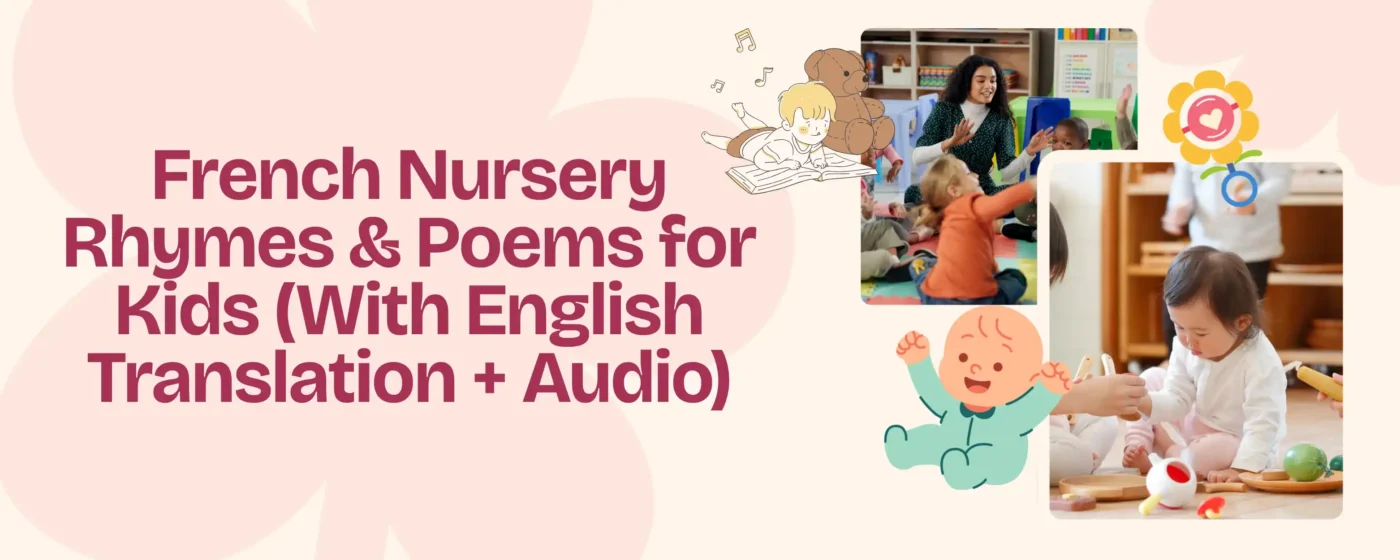
Nursery rhymes are a fun way to teach children everyday values. Their simple vocabulary also makes them a great way to learn a language. Moreover, the melodies of these rhymes make the poem more memorable and thus, easier to learn new words.
You’ll be surprised to learn that incorporating songs, rhymes and tunes into your language learning journey can give impressive results. So prepare yourself to go back in time and discover new French nursery rhymes!
What are French Nursery Rhymes?
French nursery rhymes, known as ‘comptine’ or ‘chansons d’enfants’ (children’s songs), originate from traditional folk songs. Although children read them widely, these are passed down from one generation to another with parents reciting them as lullabies and lessons.
These nursery rhymes often revolve around animals, nature, values and everyday French life. So they’re useful not only for vocabulary but also for understanding the culture.
French Children’s Songs explained and translated
Below are some of the most classic and famous French children’s songs. You’ll find many melodies to be recognizable and used in films, lullabies and other songs.
Frère Jacques
Frère Jacques is a children’s song dating back to the 17th century. It revolves around a monk who overslept and missed his duty and obligation. Therefore, teaching the moral of punctuality and waking up on time.
Frère Jacques, Frère Jacques,
Dormez-vous? Dormez-vous?
Sonnez les matines! Sonnez les matines!
Ding, dang, dong. Ding, dang, dong.
English Adaptation:
Are you sleeping? Are you sleeping?
Brother Jacques, Brother Jacques
Morning bells are ringing, Morning bells are ringing
Ding, dang, dong. Ding, dang, dong
Fun Fact: In the French version, the monk is being instructed to wake up and ring the bells, while in the English adaptation, the bells are already ringing. This shift often helps maintain the song’s rhythm and tone.
Au Clair de la Lune
Au Clair de la Lune is one of those songs that has appeared in French pop culture many times. The characters are distinct and comedic, and the lyrics contain double entendres. It follows a character who goes from one neighbour to another, asking for a pen and a light for his candles so he can write.
Au clair de la lune
Mon ami Pierrot
Prête-moi ta plume
Pour écrire un mot
Ma chandelle est morte
Je n’ai plus de feu
Ouvre-moi ta porte
Pour l’amour de Dieu
English Adaptation:
In the light of the moon
My friend Pierrot
Lend me your pen
To write a word
My candle is dead
I have no more fire
Open your door for me
For God’s sake
Ah les Crocodiles
Ah les Crocodiles narrates the story of a crocodile going to fight a war with the elephants. Seeing the vastness of the enemy elephants, the crocodile retreats. This song has had multiple versions, with the original created around the 19th century. The fast rhythmic pacing makes it a fun piece to listen to. Here are the lyrics:
Un crocodil’ s’en allant à la guerre
Disait au r’voir à ses petits enfants
Traînant la queue, la queue dans la poussière
Il s’en allait combattr’ les éléphants.
Ah les crococo, les crococo, les crocodiles
Sur les bords du Nil ils sont partis n’en parlons plus
Ah les crococo, les crococo, les crocodiles
Sur les bords du Nil ils sont partis n’en parlons plus.
English Adaptation
A crocodile is going to war
Bidding his little children farewell,
Dragging his tail, his tail in the dust
He was going to fight the elephants.
Oh the cro-co-co, the cro-co-co, the crocodiles
From the banks of the Nile, they left, say no more about it,
Oh the cro-co-co, the cro-co-co, the crocodiles
From the banks of the Nile, they left, say no more about it.
Sur le Pont d’Avignon
Dating back to the 15th century, Sur le Pont d’Avignon focuses on the famous bridge Point Saint-Bénézet in Avignon. The characters dance at this bridge, creating a beautiful imagery. There are longer and different versions, often with different or more occupations. Here are the lyrics:
Sur le Pont d’Avignon
On y danse, on y danse
Sur le Pont d’Avignon
On y danse tous en rond.
English Adaptation:
On the bridge of Avignon
We’re all dancing, we’re all dancing
On the bridge of Avignon
We all dance in circles.
Fun fact: the bridge, Saint Bénézet, was so narrow that one could not even imagine dancing on it. So, locals danced underneath it instead.
Alouette
Alouette is one of the catchiest French nursery rhymes. The lyrics describe plucking different body parts of the lark. Therefore, this song is very useful for learning vocabulary related to body parts and possessive pronouns. In every verse, the body part changes without much change to the structure of the rhyme. Find the lyrics below to begin singing along:
Alouette, gentille alouette
Alouette, je te plumerai
Je te plumerai la tête
Je te plumerai la tête
Et la tête, et la tête
Alouette, Alouette
Oh, oh, oh, oh
English Adaptation:
Alouette, sweet alouette
Alouette, I’ll pluck you
I’ll pluck your head
I’ll pluck your head
And the head, and the head
Alouette, Alouette
Oh, oh, oh, oh
Une Souris Verte
Une souris Verte (a green mouse) is believed to date back to the 17th-18th century. Although the song is about a mouse that is caught and what happens to it then, there are many more interpretations where the green mouse represents a soldier.
Moreover, over the years, people have developed different variations of its endings. The lyrics of one of the variations are:
Une souris verte
Qui courait dans l’herbe
Je l’attrape par la queue
Je la montre à ces messieurs
Ces messieurs me disent
Trempez-la dans l’huile
Trempez-la dans l’eau
Ça fera un escargot
Tout chaud
English Adaptation:
A green mouse
Running through the grass
I grab it by the tail
I show it to these gentlemen
These gentlemen say to me
Soak it in oil
Soak it in water
It will make a snail
All warmed up
Une Poule sur un Mur
Une Poule sur un Mur (A hen on a wall) is a short traditional rhyme about a hen. It is a simple verse and describes the Hen pecking the bread. This rhyme is ideal for kids and adults who wish to learn an easy French children’s song.
Une poule sur un mur
Qui picore du pain dur
Picoti, picota
Lève la queue et puis s’en va
English Adaptation:
A chicken on a wall
Pecking at hard bread
Picoti, picota
Lifts its tail and goes away
À la claire Fontaine
À la Claire Fontaine (By the Clear Fountain) is a rhyme from the 15th- 16th centuries. This song is possibly about lost love. It can even be interpreted as a song of resistance, as it was sung by French and Canadian patriots during periods of war and injustice.
À la claire fontaine
M’en allant promener
J’ai trouvé l’eau si belle
Que je m’y suis baigné
Il y a longtemps que je t’aime,
Jamais je ne t’oublierai
English Adaptation:
At the clear fountain
As I went for a walk
I found the water so beautiful
That I bathed in it
I have loved you for a long time,
I’ll never forget you
Better Learning Starts Here!
Improve your progress with proven study methods and expert advice.
Un Éléphant qui se balançait
Un elephant qui se balancait is a traditional French nursery rhyme describing an elephant swinging on a spider web as if it is a swing. It teaches counting, and therefore multiple verses can be added to the song once the structure is known.
Un éléphant se balançait
Sur une toile, toile, toile, toile d’araignée,
C’était un jeu tellement amusant
Qu’il appela… un deuxième éléphant
Deux éléphants se balançaient
Sur une toile, toile, toile, toile d’araignée,
C’était un jeu tellement amusant
Que tout d’un coup… BaDaBouM !
English Adaptation:
One elephant was swinging
On a web, web, web, a spider’s web,
It was such a fun game, so much fun
That he called… a second elephant.
Two elephants were swinging
On a web, web, web, a spider’s web,
It was such a fun game, so much fun
That suddenly… Badaboum!
Au Feu les Pompiers
Au Feu les Pompiers originates in the 20th century. It is about a fireman and the narrator explaining who caused the fire. This rhyme allows us to learn the vocabulary of occupations and add to the lyrics.
Au feu les pompiers,
V’là la maison qui brûle !
Au feu les pompiers,
V’là la maison brûlée !
C’est pas moi qui l’ai brûlée,
C’est la cantinière,
C’est pas moi qui l’ai brûlée,
C’est le cantinier.
C’est pas moi qui l’ai brûlée,
C’est mon oncle Jules,
C’est pas moi qui l’ai brûlée,
C’est mon oncle André.
English Adaptation:
Fire! Firemen,
The house is burning!
Fire! Firemen,
The house is burnt!
It wasn’t me who burned it,
It was the she-cook,
It wasn’t me who burned it,
It was the he-cook.
It wasn’t me who burned it,
It was my uncle Jules,
It was not me who burned it,
It was my uncle André.
Conclusion
After learning so much about French nursery rhymes, we can comment on their dynamic nature and how they include songs, rhymes and imagery in simple language. This feature makes them excellent for young learners. Pick your favourite rhyme and begin learning vocabulary through singing!
Frequently Asked Questions
Q1. Do nursery rhymes help with vocabulary?
Ans: Yes! Nursery rhymes are easy to learn because of their rhythm and melody. Therefore, one can easily memorise new words from rhymes.
Learning through new and unconventional methods can make the process interesting and motivating. Learn with La Fôret to experience a language learning journey that incorporates engaging methods to teach the language and help you achieve your goals!
Q2. Are French Nursery rhymes popular?
Ans: French nursery rhymes are widely known and recited. Multiple pop culture references have been made using these rhymes, and they still remain relevant.
Q3. Are French Nursery Rhymes for children only?
Ans: French nursery rhymes are for both adults and children. The meaning of the songs vary and often these rhymes are sung for adults’ entertainment as well.