Animals in French: Useful Wild animals vocabulary in French
Animals in French culture hold significant roles, from symbols in folklore to beloved pets. French language and literature frequently feature animals, reflecting their importance in daily life and national heritage. Whether in proverbs, children’s stories, or as national emblems, animals contribute to French cultural identity. Understanding their place in French society offers insights into the values and traditions that shape this vibrant culture.
Key Takeaways
- Learning common French animal names helps you expand your French vocabulary which makes your conversations sound like native.
- Exploring pets, farm animals and wild creatures in French keeps your learning interesting and helps you remember words through real-life examples.
- Noticing the gender of each animal name improves your grammar and helps you use the right articles without any mistake.
- Using basic adjectives to describe animals helps you form sentences and express ideas fluently & confidently in French.
Pets or Domestic Animals in French
Domestic animals that are often kept as pets play a very important role in everyday life. For some people pets become their best friends. Learning the names of domestic animals, known as les animaux domestiques is both practical and essential for basic communication.
| English | French | Pronunciation |
|---|---|---|
| Cat | Le chat | luh sha |
| Dog | Le chien | luh shee-ehn |
| Fish | Le poisson | luh pwah-sawn |
| Parakeets | Les perruches | lay peh-roosh |
| Rabbit | Le lapin | luh lah-pahn |
| Hamster | Le hamster | luh ahm-stehr |
| Guinea Pig | Le cochon d’Inde | luh koh-shohn dahnd |
| Turtle | La tortue | lah tor-tew |
| Snake | Le serpent | luh sehr-pahn |
| Parrot | Le perroquet | luh peh-roh-keh |

Enhance your French vocabulary with 50+ flower names in French to add a touch of elegance to your conversations and writings.
Farm Animals in French
France isn’t just about Paris. The French value countryside a lot, hence, farm animals (les animaux de la ferme) are a big part of countryside life in France and come up often in everyday vocabulary. Learning their names helps you talk about farms, food, and rural settings in a simple and natural way.
| English | French | Pronunciation |
|---|---|---|
| Cow | La vache | lah vahsh |
| Pig | Le cochon | luh koh-shon |
| Horse | Le cheval | luh shuh-val |
| Sheep | Le mouton | luh moo-ton |
| Chicken | Le poulet (or Le coq for a rooster) | luh poo-leh |
| Goat | La chèvre | lah sheh-vruh |
| Duck | Le canard | luh kah-nar |
| Turkey | La dinde | lah dand |
| Rabbit | Le lapin | luh lah-pan |
| Goose | L’oie | lwah |
Some animal nouns have irregular plural forms, such as un cheval becoming des chevaux. The word for a rooster in French is un coq, and the female chicken is une poule.

Wild Animals in French
Wild animals or forest animals (Les animaux de la forêt ) are found in nature, from forests to jungles. Knowing their French names makes it easier to talk about nature, wildlife documentaries, and the natural world.
| English | French | Pronunciation |
|---|---|---|
| Lion | Le lion | luh lee-on |
| Tiger | Le tigre | luh tee-gruh |
| Elephant | L’éléphant | lay-lay-fon |
| Giraffe | La girafe | la zhee-raf |
| Bear | L’ours | loors |
| Wolf | Le loup | luh loo |
| Deer | Le cerf | luh serf |
| Fox | Le renard | luh ruh-nar |
| Zebra | Le zèbre | luh zeb-ruh |
| Kangaroo | Le kangourou | luh kan-goo-roo |

Lost for Words? We’ve Got You!
Sign up for our courses and let our expert teachers boost your vocabulary effortlessly!
Sea Animals in French
Sea animals also known as marine animals such as fishes are found in oceans, rivers, and seas, and they’re often used in science and travel topics. Learning their names in French helps you describe marine life in a clear and interesting way.
| English | French | Pronunciation |
|---|---|---|
| Fish | Le poisson | luh pwah-sohn |
| Dolphin | Le dauphin | luh doh-fan |
| Shark | Le requin | luh ruh-kan |
| Whale | La baleine | lah bah-len |
| Octopus | La pieuvre | lah pyuh-vruh |
| Crab | Le crabe | luh krahb |
| Sea Turtle | La tortue de mer | lah tor-tyu duh mehr |
| Seal | Le phoque | luh fok |
| Jellyfish | La méduse | lah may-dyooz |
| Lobster | Le homard | luh oh-mar |

Insects and Small Critters Name in French
Insects and small critters are all around us, even if we don’t always notice them. They play very important roles in pollination such as a bee, une abeille and other insects like an ant, une fourmi. Their French names are useful for everyday descriptions of nature and outdoor life.
| English | French | Pronunciation |
|---|---|---|
| Ant | La fourmi | lah for-mee |
| Bee | L’abeille | lah-bay |
| Butterfly | Le papillon | luh pah-pee-yohn |
| Spider | L’araignée | lah-ray-nay |
| Ladybug | La coccinelle | lah kok-see-nel |
| Mosquito | Le moustique | luh moo-steek |
| Fly | La mouche | lah moosh |
| Wasp | La guêpe | lah gep |
| Grasshopper | Le sauterelle | luh so-tuh-rel |
| Beetle | Le scarabée | luh ska-rah-bay |

Birds in French
Birds are very versatile, they can be kept as pets but are also easy to spot. The French word for a bird is un oiseau. Learn French names of birds to help you describe what you see and hear in everyday surroundings. Here is a small list of birds-
| English | French | Pronunciation |
|---|---|---|
| Eagle | L’aigle | legl |
| Sparrow | Le moineau | luh mwah-no |
| Owl | Le hibou | luh ee-boo |
| Pigeon | Le pigeon | luh pee-zhon |
| Parrot | Le perroquet | luh peh-roh-kay |
| Crow | Le corbeau | luh kor-bo |
| Seagull | La mouette | lah moo-et |
| Peacock | Le paon | luh pah |
| Flamingo | Le flamant rose | luh flah-mon roze |
| Swallow | L’hirondelle | lee-ron-del |

Expand your French vocabulary with this detailed list of 50+ bird names in French to enhance your language skills effortlessly.
Reptiles & Amphibians in French
Reptiles and amphibians might not be seen every day, but they’re an important part of nature. Knowing their French names helps you talk about different kinds of animals more accurately.
| English | French | Pronunciation |
|---|---|---|
| Snake | Le serpent | luh ser-pahn |
| Lizard | Le lézard | luh lay-zar |
| Frog | La grenouille | lah gruh-noo-y |
| Toad | Le crapaud | luh krah-poh |
| Turtle | La tortue | lah tor-tyu |
| Crocodile | Le crocodile | luh kroh-ko-deel |
| Alligator | L’alligator | lah-lee-gah-tor |
| Chameleon | Le caméléon | luh kah-may-le-on |
| Salamander | La salamandre | lah sah-lah-mahn-druh |
| Gecko | Le gecko | luh geh-ko |

Baby Animals in French
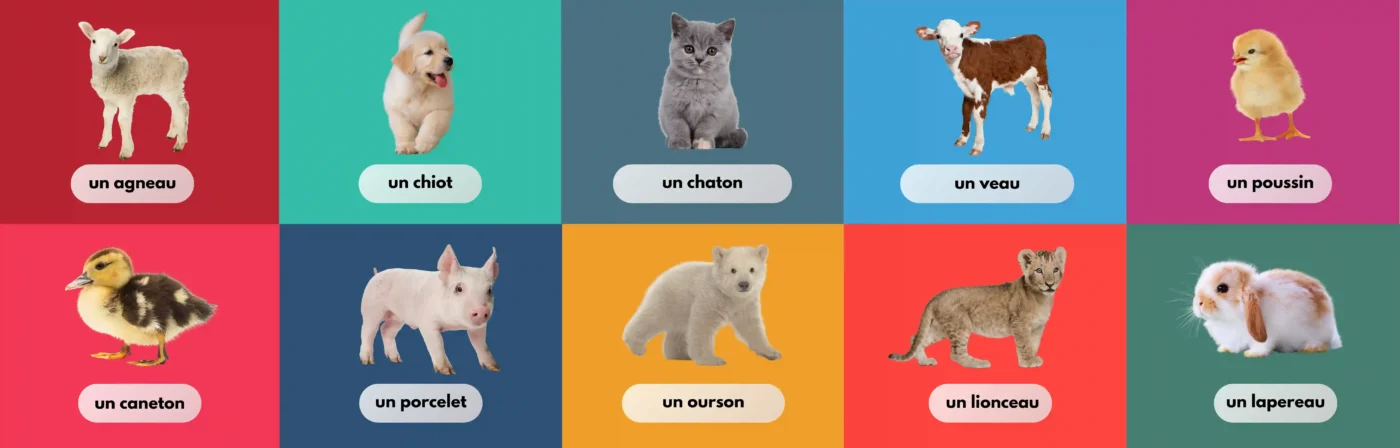
Baby animal names in French offer a fun and surprisingly eye-opening way to explore the language. Instead of simply modifying the adult animal names, French often uses entirely different words, making them more interesting and memorable. As you discover these terms, you begin to appreciate the richness and detail of the language. It’s a simple yet effective way to make your French sound more natural, vivid, and expressive.
| English | French | Pronunciation |
|---|---|---|
| Lamb | un agneau | a-nyo |
| Puppy | un chiot | shyo |
| Kitten | un chaton | sha-ton |
| Calf | un veau | voh |
| Chick | un poussin | poo-san |
| Duckling | un caneton | ka-ne-ton |
| Piglet | un porcelet | por-se-lay |
| Bear cub | un ourson | oor-son |
| Lion cub | un lionceau | lee-on-so |
| Baby rabbit | un lapereau | la-pe-ro |
Animal/Birds Body Parts Name in French
Knowing animal body parts in French helps you describe animals more clearly, especially when talking about appearance or behavior.
| English | French | Pronunciation | Example Sentence |
|---|---|---|---|
| Tail | La queue | /la kə/ | “Le chat agite sa queue.” (The cat is wagging its tail.) |
| Wing | L’aile | /lɛl/ | “L’oiseau déploie ses ailes.” (The bird spreads its wings.) |
| Paw | La patte | /la pat/ | “Le chien a une patte blessée.” (The dog has an injured paw.) |
| Beak | Le bec | /lə bɛk/ | “Le perroquet a un bec coloré.” (The parrot has a colorful beak.) |
| Fur | La fourrure | /la fuʁyʁ/ | “Le lapin a une fourrure douce.” (The rabbit has soft fur.) |
| Feather | La plume | /la plym/ | “Le paon montre ses plumes.” (The peacock shows its feathers.) |
| Claw | La griffe | /la gʁif/ | “Le lion a des griffes puissantes.” (The lion has powerful claws.) |
| Fin | La nageoire | /la naʒwaʁ/ | “Le requin a des nageoires.” (The shark has fins.) |
| Mane | La crinière | /la kʁinjɛʁ/ | “Le lion a une crinière majestueuse.” (The lion has a majestic mane.) |
| Snout | Le museau | /lə myzo/ | “Le cochon utilise son museau pour fouiller.” (The pig uses its snout to root around.) |
Animal Verbs List in French
Animals are often linked to specific actions like barking or flying. Learning these verbs in French makes your descriptions more lively and expressive.
| French Verb | English Translation | Example Sentence in French | English Translation |
|---|---|---|---|
| aboyer | to bark | Le chien aboie fort. | The dog is barking loudly. |
| miauler | to meow | Le chat miaule quand il a faim. | The cat meows when it’s hungry. |
| rugir | to roar | Le lion rugit dans la savane. | The lion roars in the savannah. |
| hennir | to neigh | Le cheval hennit joyeusement. | The horse neighs joyfully. |
| siffler | to whistle | L’oiseau siffle une mélodie. | The bird whistles a tune. |
| ronronner | to purr | Le chat ronronne sur mes genoux. | The cat purrs on my lap. |
| grogner | to growl | Le chien grogne en jouant. | The dog growls while playing. |
| gazouiller | to chirp | Les oiseaux gazouillent au lever du soleil. | The birds chirp at sunrise. |
| bondir | to leap | Le lapin bondit dans le jardin. | The rabbit leaps in the garden. |
| griffer | to scratch | Le chat griffe le canapé. | The cat scratches the sofa. |
Animal/Bird Idioms in French
Animal and bird idioms play a significant role in language and culture by reflecting common beliefs, values, and experiences. They create vivid imagery, making expressions more colorful and memorable. Universally resonant due to the familiarity of animals, these idioms often impart moral lessons, such as “The early bird catches the worm,” encouraging promptness.
They add humor and wit to conversations, describe character traits in relatable ways, and evoke emotional connections. Examples like “a fish out of water” for feeling out of place or “letting the cat out of the bag” for revealing a secret unintentionally demonstrate how these idioms enrich communication by drawing on the natural world.
Here are some French idiomatic expressions involving animals, their literal translations, meanings in English:
| French Idiom | Literal Translation | Meaning in English | Example Sentence |
|---|---|---|---|
| Avoir un chat dans la gorge | To have a cat in the throat | To have a frog in one’s throat (hoarse voice) | Ce matin, j’ai un chat dans la gorge et je peux à peine parler. |
| Poser un lapin | To put a rabbit | To stand someone up | Il m’a posé un lapin et je suis resté seul au restaurant. |
| Avoir une mémoire d’éléphant | To have an elephant’s memory | To have a very good memory | Elle a une mémoire d’éléphant, elle se souvient de tout. |
| Être comme un poisson dans l’eau | To be like a fish in water | To be very comfortable in a situation | Il est comme un poisson dans l’eau dans son nouveau travail. |
| Appeler un chat un chat | To call a cat a cat | To call a spade a spade | Il faut appeler un chat un chat et admettre nos erreurs. |
| Avoir d’autres chats à fouetter | To have other cats to whip | To have other fish to fry | Je ne peux pas m’occuper de cela maintenant, j’ai d’autres chats à fouetter. |
| Donner sa langue au chat | To give one’s tongue to the cat | To give up guessing | Je donne ma langue au chat, je ne trouve pas la réponse. |
| Être comme chien et chat | To be like dog and cat | To fight like cats and dogs | Ces deux-là sont toujours en train de se disputer, comme chien et chat. |
| Avoir une faim de loup | To have a wolf’s hunger | To be very hungry | Après cette randonnée, j’ai une faim de loup. |
| Chercher la petite bête | To look for the little beast | To nitpick | Arrête de chercher la petite bête et sois content du résultat. |
French Expressions Containing Animal Life Vocabulary
French expressions that include animal vocabulary add color and personality to the language. Rather than being literal, these phrases often carry deeper meanings and reflect cultural insights. For example, avoir une mémoire d’éléphant (to have a very good memory), donner sa langue au chat (to give up guessing), and être têtu comme une mule (to be very stubborn). These expressions make everyday French more vivid, playful, and expressive.
Mythological Creatures and Animals in French
Mythological creatures in French introduce learners to a world where language meets imagination and storytelling. Terms like un dragon (dragon), un phénix (phoenix), une licorne (unicorn), and un griffon (griffin) bring legends to life. Exploring these words not only expands your word bank but also makes learning more engaging, creative, and memorable.
Conclusion
Animals play a significant role in French culture, from symbols in folklore to cherished pets. Their presence in language and literature reflects deep-rooted traditions and values. To further explore French vocabulary, visit our blog page for more insights.
Enhance your French language skills with essential Environment & Ecology Vocabulary in French to discuss sustainability and environmental topics fluently.
Did you know? The French term “cocorico” mimics a rooster’s crow and symbolizes national pride.